
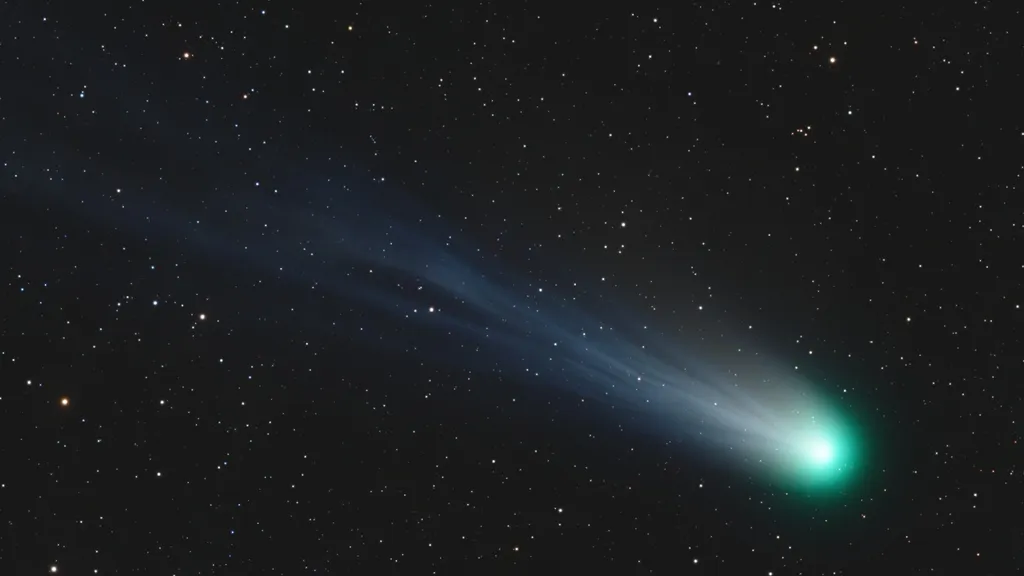
In a recent study, a team of astronomers led by Qicheng Zhang from the University of Maryland and the Planetary Science Institute, along with colleagues from the U.S. Naval Research Laboratory and the International Astronomical Union’s Minor Planet Center, have uncovered new insights into the behavior of a previously overlooked comet.
The comet in question is (139359) 2001 ME1, which was first identified as an asteroid but has now been found to exhibit cometary activity. The researchers used data from the Solar and Heliospheric Observatory (SOHO) and the Solar Terrestrial Relations Observatory (STEREO) to study the comet’s behavior as it passed near the Sun. They found that the comet’s dust activity near its closest approach to the Sun (perihelion) was amplified by the efficient forward scattering of sunlight, making it appear much brighter than it would otherwise.
The team also compared the brightness of this comet to that of another comet, 2P/Encke, which was observed under similar conditions in 2017. They found that while 2P/Encke was more active, it was also optically dust-poor, meaning it did not scatter light as efficiently. This comparison helped the researchers better understand the unique properties of (139359) 2001 ME1.
The researchers also analyzed earlier observations from STEREO dating back to 2014 and found that the comet’s activity is recurrent, meaning it exhibits similar behavior each time it passes near the Sun. This suggests that the comet’s activity has been ongoing for some time but has gone unnoticed due to its faintness and proximity to the Sun.
The team also conducted orbital integrations, which showed that the comet has likely followed a near-Earth orbit for at least the past 10,000 years. This suggests that the comet’s weak activity is likely due to its continued depletion of accessible volatiles, such as water ice, over time.
The study, titled “Covertly Active Comet (139359) 2001 ME1,” was published in the Astronomical Journal. While this research may not have direct implications for the energy industry, it contributes to our understanding of the solar system and the behavior of small bodies within it. This knowledge can be valuable for future space missions and the development of technologies for exploring and utilizing resources in space.
In summary, the researchers have identified a previously overlooked comet that exhibits recurrent activity near the Sun. By studying this comet and comparing it to others, they have gained new insights into the behavior of small bodies in our solar system. This research was published in the Astronomical Journal.
This article is based on research available at arXiv.