
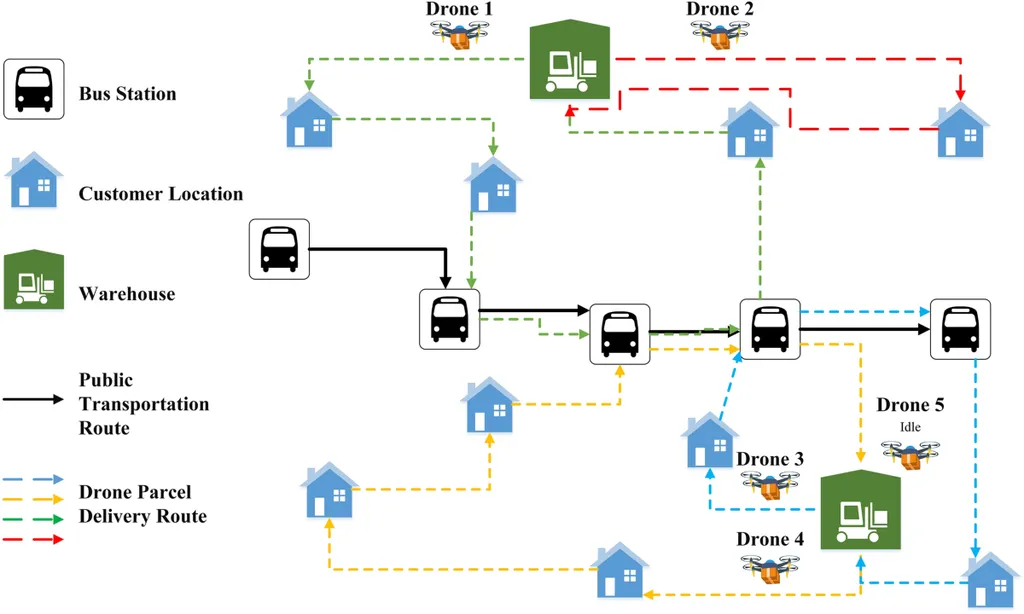
Researchers Boshuai Zhao, Jakob Puchinger, and Roel Leus from the KU Leuven in Belgium have published a study on optimizing drone and modular vehicle routing for transportation services. Their work, titled “The Dial-a-Ride Problem with Synchronized Visits,” was published in the journal Transportation Science.
The study addresses the challenge of efficiently routing a fleet of drones or small vehicles to serve customers with varying demands. Large customers, whose needs exceed a single vehicle’s capacity, require multiple units to serve them simultaneously. In contrast, smaller customers can be consolidated into one trip. The researchers aim to minimize the cost of transporting orders by developing new mathematical models and algorithms for this complex routing problem.
The team proposed four different formulations to tackle this problem: arc-based, event-based, time-space event-based (TSEF), and time-space fragment-based (TSFrag). An event is defined as a combination of a location and a set of onboard customers, while a fragment represents a partial path. For the TSEF and TSFrag formulations, the researchers also employed the dynamic discretization discovery (DDD) algorithm. This algorithm iteratively refines an initial low-resolution time-space network to achieve a continuous-time optimal solution.
The computational results demonstrated that the event-based formulation performs best under low request intensity, where there are few customers per unit time. Conversely, the TSFrag formulation with DDD excels in high request intensity scenarios. Both of these approaches substantially outperform the arc-based formulation. Additionally, when implemented with DDD, TSFrag requires less time and fewer iterations than TSEF.
The researchers also applied their methods to the classical dial-a-ride problem. They found that TSFrag with DDD can replace callbacks in case of high request intensity. Furthermore, using DDD was found to be more beneficial for the dial-a-ride problem than for the pickup-and-delivery problem with time windows.
This research has practical applications for the energy industry, particularly in the context of last-mile delivery and logistics. As drones and small modular vehicles become more prevalent for transporting goods and services, efficient routing and scheduling will be crucial for minimizing costs and maximizing efficiency. The formulations and algorithms developed in this study can help energy companies optimize their delivery services, reduce operational costs, and improve overall performance.
Source: Zhao, B., Puchinger, J., & Leus, R. (2023). The Dial-a-Ride Problem with Synchronized Visits. Transportation Science.
This article is based on research available at arXiv.