
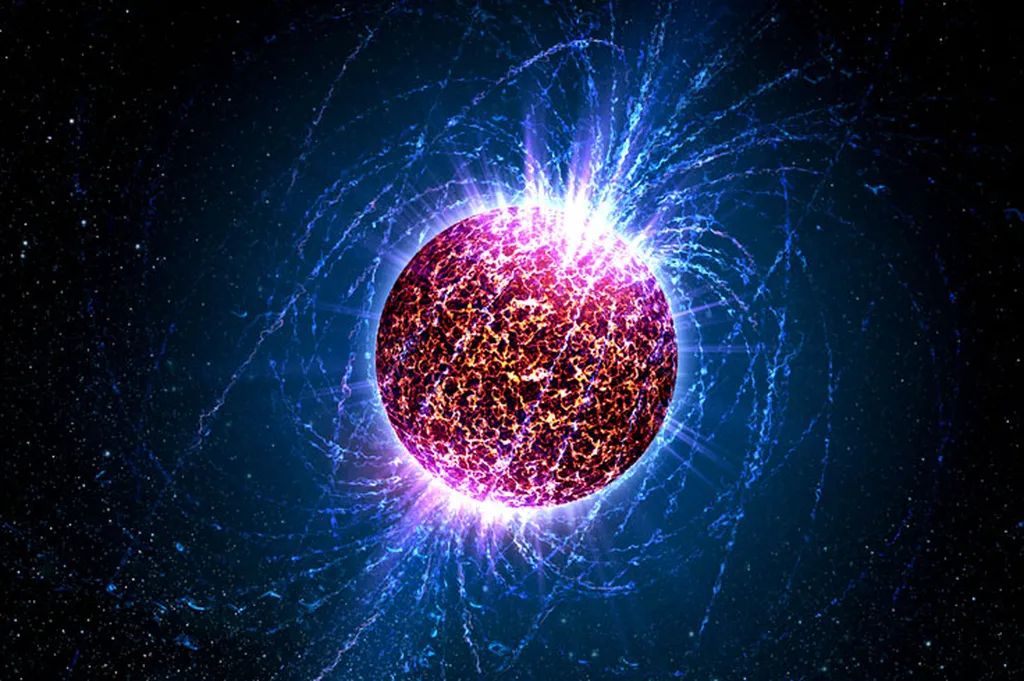
In the realm of astrophysics and energy research, understanding the intricate properties of neutron stars can provide valuable insights into the fundamental forces and matter at extreme densities. Researchers A. C. Khunt, K. Yavuz Ekşi, and P. C. Vinodkumar from the Department of Physics at Bilkent University in Turkey have delved into the impact of pressure anisotropy on the structure and geometry of neutron stars within the framework of general relativity. Their findings, published in the journal Physical Review D, offer a nuanced look at how anisotropic stresses influence key observables and internal gravitational fields of these celestial bodies.
The team focused primarily on the Bowers-Liang (BL) model, a phenomenological approach to describing pressure anisotropy, and compared their results with a quasi-local prescription. Using the SLy equation of state, which describes the relationship between pressure and density in neutron star matter, they explored how anisotropic stresses affect global observables such as mass-radius relations, moment of inertia, compactness, and tidal deformability. Their analysis covered a broad range of anisotropy parameters.
One of the key findings is that moderate positive anisotropy can significantly alter the maximum mass a neutron star can support. The researchers found that this maximum mass can increase up to approximately 2.4 times the mass of the Sun (M☉) and enhance stellar compactness by up to 20% compared to isotropic configurations. Importantly, these modifications remain consistent with current observational constraints from the Neutron star Interior Composition Explorer (NICER) and gravitational-wave data.
To probe the internal gravitational field, the researchers computed various curvature invariants, including the Ricci scalar, the Ricci tensor contraction, the Kretschmann scalar, and the Weyl scalar. They discovered that curvature measures directly tied to the matter distribution exhibit a strong sensitivity to anisotropy. In contrast, the Weyl curvature, which reflects the free gravitational field, remains comparatively insensitive. Within the BL framework, the maximum compactness increases with anisotropy, reaching values as high as 0.25 to 0.38 for a range of anisotropy parameters. However, the physical realizability of such highly compact configurations depends on the underlying anisotropy mechanism.
The study also highlighted the strong model dependence of anisotropic effects, underscoring both the potential significance and the limitations of phenomenological anisotropy prescriptions in modeling the interiors of neutron stars. This research not only advances our understanding of neutron star structure but also has implications for the energy sector, particularly in the development of advanced energy technologies that rely on a deep understanding of fundamental physics and extreme conditions.
The findings were published in Physical Review D, a prestigious journal in the field of theoretical and experimental particle physics, gravitation, and cosmology. This research contributes to the broader effort to unravel the mysteries of neutron stars and their potential applications in energy research, offering a glimpse into the complex interplay between matter and gravity at the most extreme scales.
This article is based on research available at arXiv.