
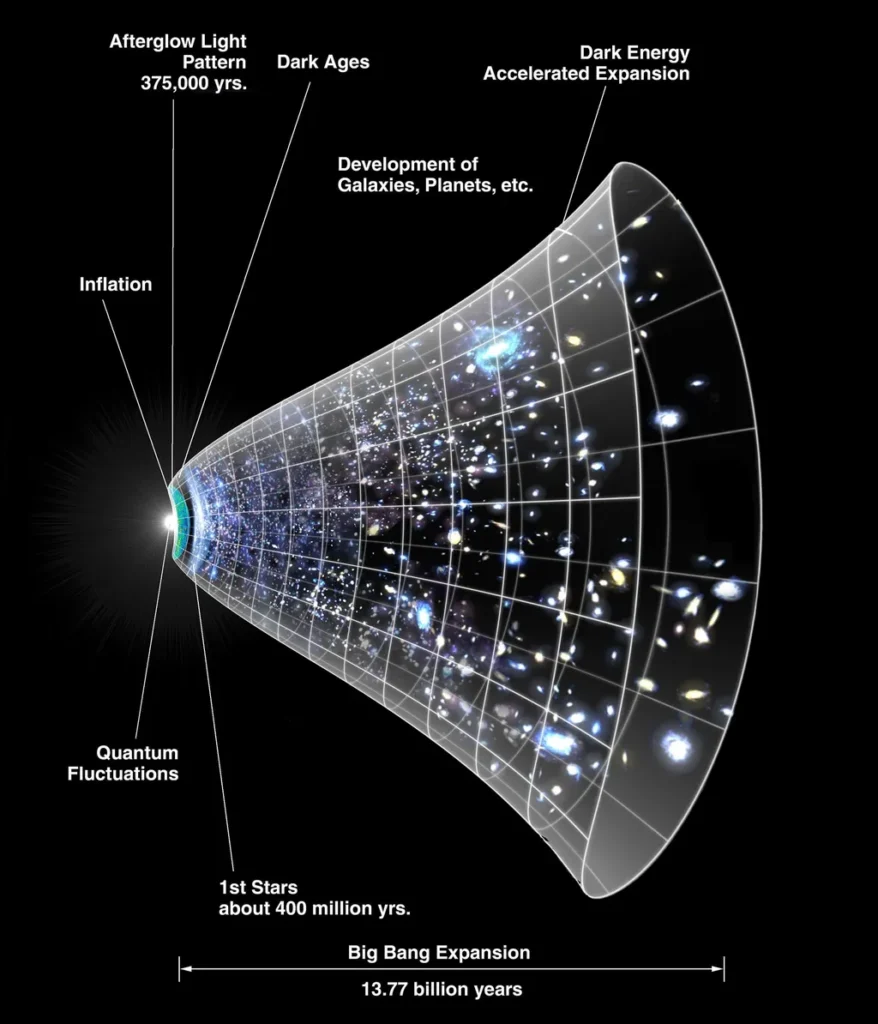
In the quest to understand the universe’s accelerating expansion, a team of researchers led by Diego Garza from the University of California, Santa Cruz, has been investigating the nature of dark energy. Their work, published in the journal Physical Review D, explores how a dynamic form of dark energy might leave its mark on the cosmic web, potentially offering new insights for the energy sector’s understanding of fundamental physics.
Dark energy is a mysterious force that makes up about 68% of the universe’s energy density and is responsible for the observed acceleration of cosmic expansion. While the simplest explanation, a constant energy known as the cosmological constant (Lambda), fits many observations, recent measurements from the Dark Energy Spectroscopic Instrument (DESI) Collaboration suggest that dark energy’s properties might change over time. This dynamic dark energy (DDE) could have significant implications for our understanding of the universe and, by extension, the fundamental forces that govern energy.
To explore these implications, Garza and his team, including Brant Robertson, Piero Madau, and others from institutions like UC Santa Cruz, UC San Diego, and the University of Chicago, conducted cosmological hydrodynamical simulations. These simulations modeled the formation of cosmic structures under different dark energy scenarios. They found that DDE models consistent with DESI’s measurements induce a spectral tilt in the Lyman-Alpha forest—a pattern of absorption lines in the spectra of distant galaxies and quasars caused by neutral hydrogen in the intergalactic medium. This tilt is scale- and redshift-dependent, differing from the standard Lambda-CDM cosmological model.
The simulations also revealed that DDE models result in higher temperatures in the intergalactic medium and reduced Lyman-Alpha opacity compared to the Lambda-CDM model. These findings suggest that observations of the Lyman-Alpha forest could provide independent confirmation of dynamic dark energy, offering a new avenue for probing the nature of this enigmatic force.
For the energy sector, understanding the fundamental nature of dark energy is crucial. It could lead to advancements in theoretical physics that might one day translate into practical applications, such as new energy technologies or a deeper comprehension of the forces that govern the universe. While the practical applications of this research are still far off, the insights gained from studying dark energy could have profound implications for our understanding of energy and the cosmos.
The research was published in Physical Review D, a peer-reviewed journal dedicated to publishing fundamental research in all areas of theoretical and experimental particle physics, gravity, and cosmology.
This article is based on research available at arXiv.