
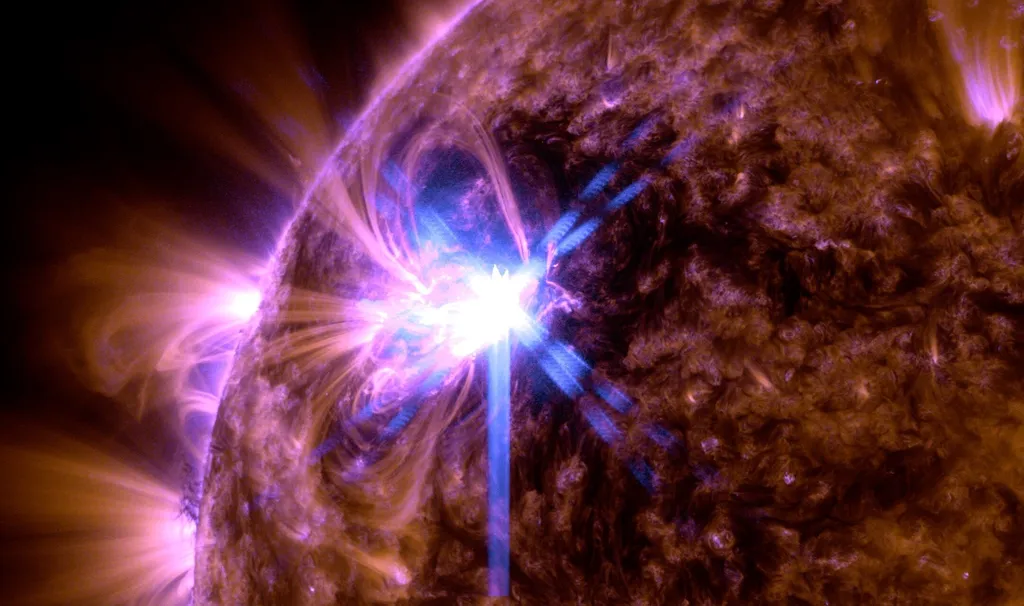
In a recent study published in the journal Nature Astronomy, a team of researchers led by Alexander I. Shapiro from the Space Research Institute of the Austrian Academy of Sciences has uncovered a fascinating phenomenon that could have implications for our understanding of stellar flares and, potentially, the energy industry. The team includes experts from various institutions, such as the Massachusetts Institute of Technology, the University of Graz, and the University of Colorado Boulder.
The researchers focused on the TRAPPIST-1 system, a star much cooler and smaller than our Sun, and found that its flares reach temperatures much lower than typical solar flares. While solar flares can peak at around 9000–10000 K, TRAPPIST-1’s flares only reach about 3500–4000 K. This significant difference led the team to investigate the underlying mechanisms regulating these temperatures.
Their findings reveal that the cool, dense atmosphere of TRAPPIST-1 plays a crucial role. In such an environment, magnetic heating—responsible for the intense energy release in flares—is moderated by the dissociation of molecular hydrogen (H2) into atomic hydrogen. This process acts like a thermostat, preventing flare regions from heating above approximately 4000 K. The researchers demonstrated through chemical equilibrium and heat capacity calculations that this effect is highly sensitive to the stellar atmospheric pressure and the local abundance of H2.
For hotter stars, including early M dwarfs and solar-type stars, the scarcity of molecular hydrogen means this mechanism is ineffective. Instead, the ionization of atomic hydrogen limits flare temperatures to around 9000 K. This discovery highlights the importance of considering the unique atmospheric conditions of different stars when studying stellar flares.
While this research primarily advances our understanding of astrophysical phenomena, it also holds potential implications for the energy industry. Understanding the behavior of molecular hydrogen in extreme environments could inform the development of more efficient and safe hydrogen-based energy technologies. For instance, the dissociation and recombination of hydrogen molecules are critical processes in hydrogen fuel cells and combustion engines. Insights from this study could contribute to optimizing these processes, enhancing the performance and reliability of hydrogen energy systems.
In summary, the team’s work sheds light on the intricate mechanisms regulating stellar flare temperatures, offering valuable knowledge that could extend beyond astronomy into practical applications within the energy sector.
This article is based on research available at arXiv.