
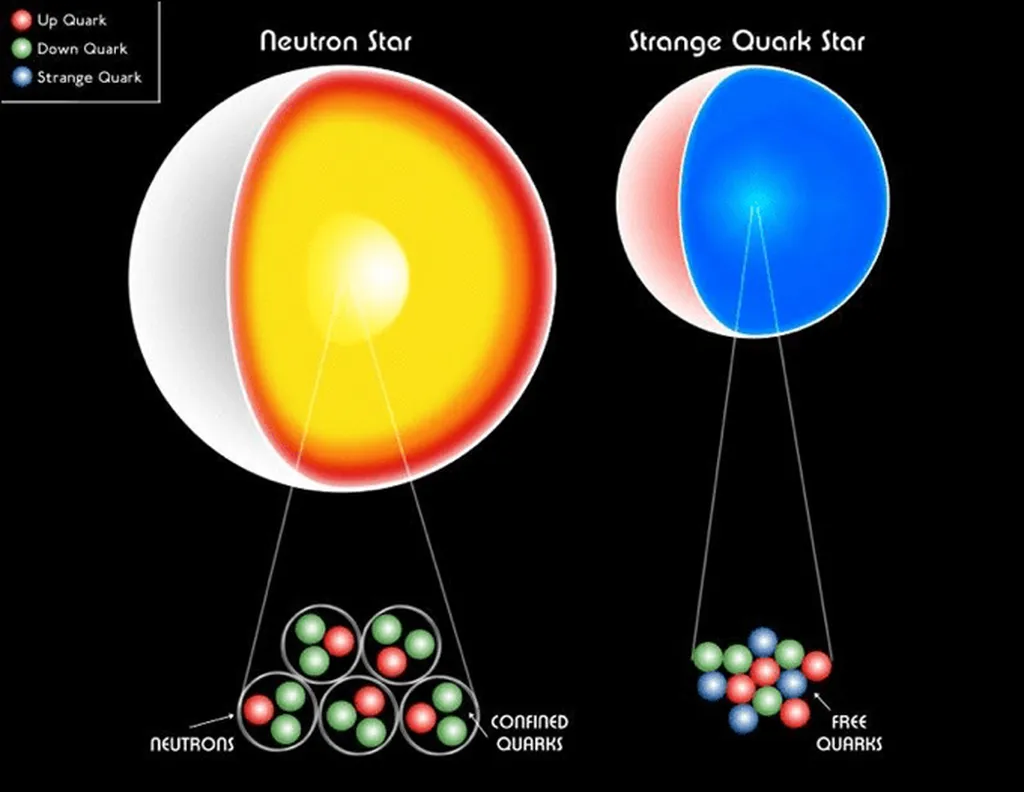
In the realm of astrophysics and energy research, a team of scientists from various institutions, including the University of Chinese Academy of Sciences and the University of Science and Technology of China, has delved into the intriguing differences between quark stars and neutron stars, and their potential impact on gravitational waves. Their work, published in the journal Physical Review D, offers insights that could refine our understanding of these celestial bodies and their role in the energy dynamics of the universe.
Quark stars and neutron stars are both remnants of massive stars that have ended their lives in supernova explosions. However, their internal compositions differ significantly. Neutron stars are composed primarily of neutrons, while quark stars are theorized to contain strange matter, a type of quark matter that is more stable than ordinary nuclear matter. The researchers focused on the f-mode frequency and tidal overlap of quark stars, using full general relativity methods to calculate these properties.
The team verified that the universal relations obtained from conventional neutron stars also hold true for quark stars, but with some notable differences. Specifically, quark stars have significantly smaller radii compared to neutron stars in the low mass range. This difference alters the relationship between tidal deformability and the product of f-mode frequency and radius. Tidal deformability is a measure of how easily a star’s shape can be altered by the gravitational pull of a nearby object, such as a black hole.
The researchers explored the implications of these differences on dynamical tides, which are the tidal forces that act on a star as it spirals into a black hole. They found that the altered relationship between tidal deformability and f-mode frequency times radius in quark stars leads to a different tidal dephasing effect. Tidal dephasing is a shift in the phase of the gravitational waves emitted by the inspiraling star. However, the team concluded that this effect is too small to be detected even by next-generation gravitational wave detectors.
While this research may not have immediate practical applications for the energy sector, it contributes to our fundamental understanding of the universe and the behavior of matter under extreme conditions. This knowledge could inform future developments in energy research, particularly in areas related to nuclear physics and the behavior of matter at high densities. Moreover, the study of gravitational waves and their sources is a rapidly evolving field, and insights gained from this research could pave the way for new discoveries and technologies in the future.
Source: Gao, D., Kuan, H., Zhou, Y., Miao, Z., Gao, Y., Zhang, C., & Zhou, E. (2023). Difference between quark stars and neutron stars in universal relations and their effect on gravitational waves. Physical Review D, 107(6), 063011.
This article is based on research available at arXiv.