
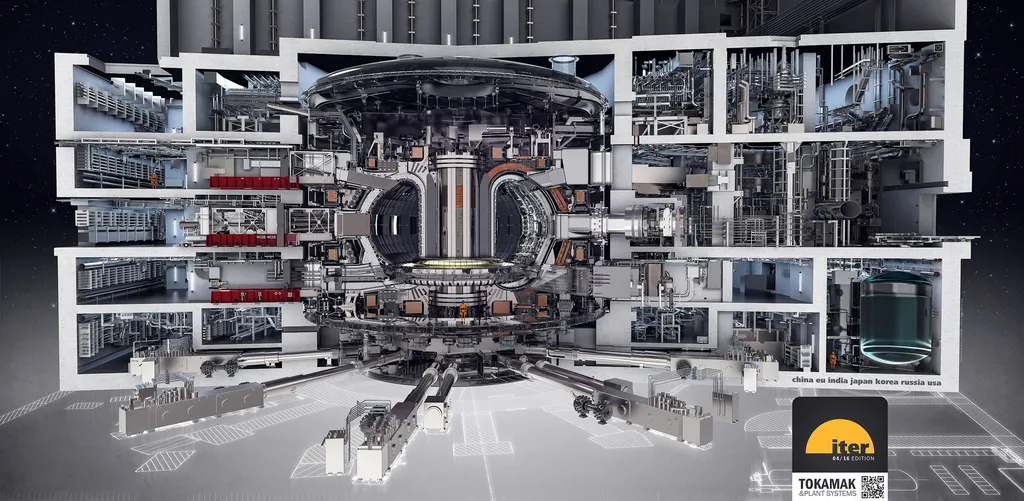
In the realm of energy research, a team of scientists from General Atomics, Princeton Plasma Physics Laboratory, and Lawrence Livermore National Laboratory has made strides in predicting the performance of the International Thermonuclear Experimental Reactor (ITER), a global project aimed at demonstrating the feasibility of fusion power. The researchers, led by Dmitri M Orlov, have published their findings in a study titled “Predicting core transport in ITER baseline discharges with neon injections.”
The study focuses on the critical task of predicting core transport and divertor power exhaust in ITER under realistic impurity conditions. This is essential for achieving self-consistent performance predictions for the fusion reactor. The researchers used the OMFIT STEP workflow to conduct a systematic power-flow and impurity-content study for the ITER 15 MA baseline scenario. They constrained their models directly by existing SOLPS-ITER neon-seeded divertor solutions.
Using the TGYRO code, the team predicted stationary temperature and density profiles for a range of effective ionic charge numbers (Z_eff) between 1.5 and 2.5. They found that the power crossing the separatrix (P_sep) varied by more than a factor of 1.7 across this scan. Notably, P_sep matched the approximately 100 MW prediction from SOLPS-ITER when Z_eff was around 1.6 or when auxiliary heating was reduced to about 75% of nominal levels.
The researchers also explored the impact of rotation sensitivity, finding that plausible variations in toroidal flow magnitude modified P_sep by less than 20%. Additionally, AURORA modeling confirmed that charge-exchange radiation inside the separatrix was dynamically negligible under the predicted ITER neutral densities.
The study identifies a compatibility window where core transport predictions align with neon-seeded divertor protection targets. This window is defined by Z_eff values between approximately 1.6 and 1.75, and auxiliary heating levels between 75% and 100% of nominal. This self-consistent, model-constrained framework provides actionable guidance for impurity control and auxiliary-heating scheduling in early ITER operation. It also supports future whole-device scenario optimization.
The practical applications of this research are significant for the energy sector, particularly in the development of fusion power. By providing a more accurate prediction of ITER’s performance, this study helps pave the way for the successful operation of the world’s largest tokamak and brings us closer to realizing the potential of fusion energy as a clean, sustainable power source. The research was published in the journal Nuclear Fusion.
This article is based on research available at arXiv.