
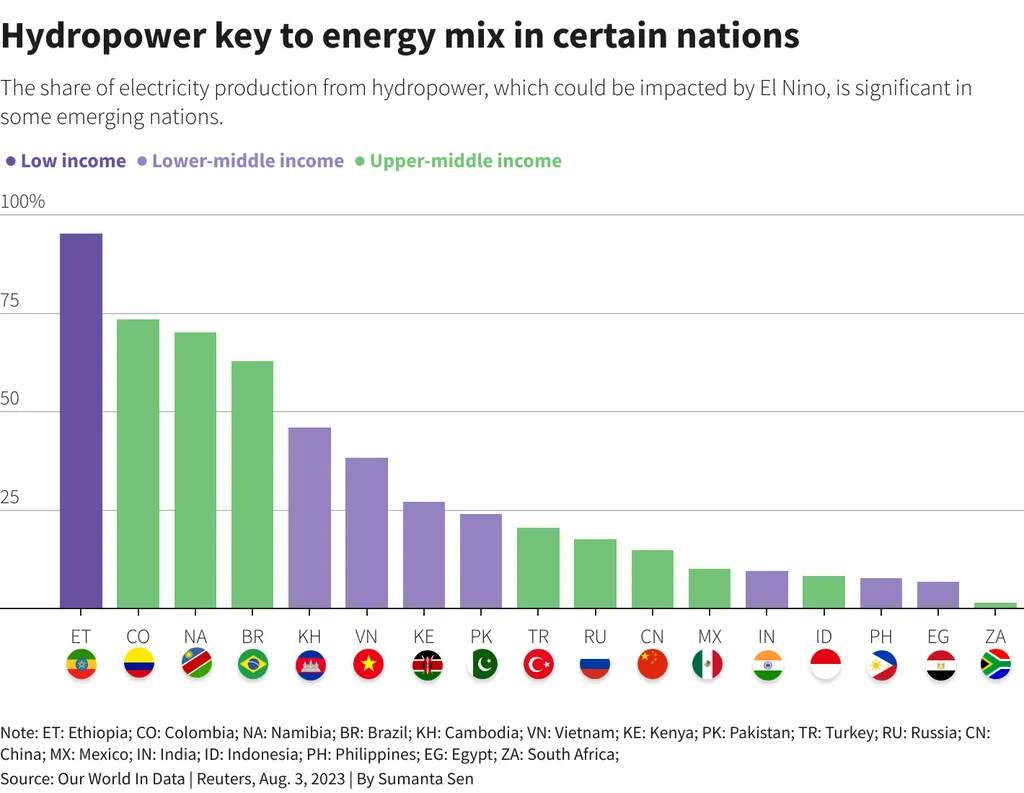
Researchers Georg A. Gottwald from the University of Sydney, Eli Tziperman from Harvard University, and Alexey Fedorov from Yale University have published a study in the journal “Chaos” that explores different mathematical models for representing westerly wind bursts (WWBs) and their impact on El Niño events. Their work aims to improve our understanding of these climate phenomena, which can have significant implications for the energy sector, particularly in regions dependent on hydroelectric power or agriculture.
El Niño events, characterized by unusually warm sea surface temperatures (SSTs) in the Equatorial Pacific, can disrupt weather patterns worldwide. These events are influenced by WWBs, which amplify El Niño and can lead to more severe impacts. The researchers focused on a specific model of El Niño, known as the recharge oscillator model, which is driven by random fluctuations or “noise” representing WWBs.
Traditionally, these random fluctuations have been modeled using state-dependent Gaussian noise, which effectively reproduces the amplification of warm events. However, the researchers found that this approach does not accurately capture many properties of WWBs and their effects on SSTs. Instead, they propose a new model using conditional additive and multiplicative (CAM) noise, which better represents the sporadic nature of WWBs. This model also generates an asymmetry between El Niño and La Niña events without the need for deterministic nonlinearities, and it produces a more monotonic increase of extreme warming events with a higher frequency of WWBs.
To cover the full spectrum of warm events, the researchers suggest a conditional noise model. In this model, the wind stress is represented by additive Gaussian noise for smaller SSTs and by additive CAM noise once the SST exceeds a certain threshold. This approach effectively captures the observed properties of WWBs and their impact on SSTs.
The practical applications of this research for the energy sector lie in improved climate modeling and prediction. Accurate representation of WWBs and their effects on El Niño events can enhance our ability to forecast climate patterns, enabling better preparation and mitigation strategies for the energy industry. This includes managing hydroelectric power generation, planning for agricultural impacts, and preparing for potential disruptions in energy supply chains due to extreme weather events.
In summary, the researchers have developed a more accurate model for representing WWBs and their impact on El Niño events, which can contribute to improved climate predictions and better inform the energy sector’s planning and decision-making processes. The study was published in the journal “Chaos,” a publication of the American Institute of Physics.
This article is based on research available at arXiv.