
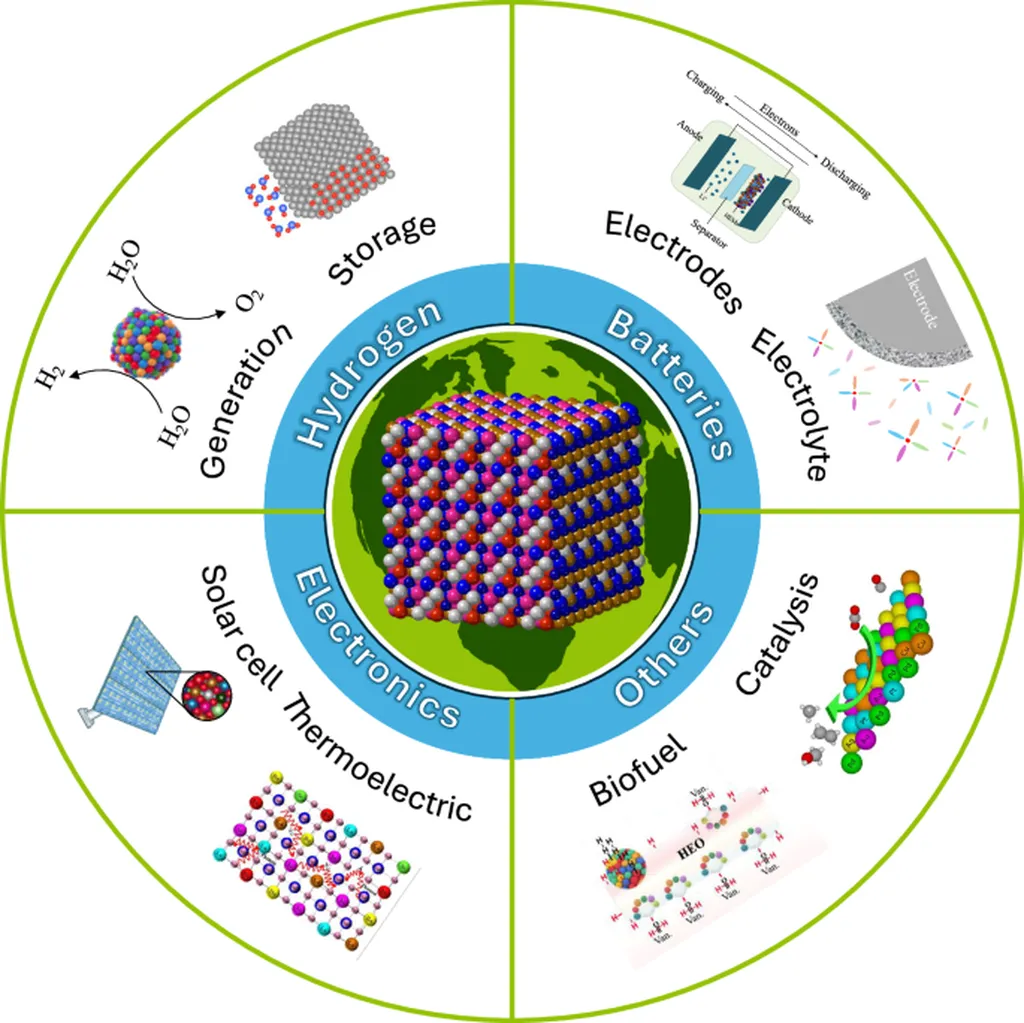
Researchers from a multinational collaboration, including scientists from the University of Lyon, the University of Ljubljana, and KTH Royal Institute of Technology, have made a significant discovery about high entropy alloys (HEAs) and their potential applications in nonlinear optics. This research, published in the journal Nature Communications, challenges conventional understanding of material properties and opens up new possibilities for sustainable optical materials.
High entropy alloys are a class of materials that combine multiple elements in roughly equal proportions, leading to a unique state of chemical disorder within a crystalline structure. This duality of order and disorder has been shown to enable novel properties, particularly in the field of nonlinear optics. The researchers demonstrated that the chemical disorder in five-element HEAs allows them to generate second optical harmonics, surpassing the theoretical limits imposed on centrosymmetric crystals. This means that HEAs can potentially be used to create more efficient and versatile optical devices.
The study also revealed that the inherent disorder in HEAs sets a threshold for nonlinear light emission, extending from the fourth to the twenty-sixth order. This broad range of emission, spanning visible (400-650 nm) and infrared (800-1600 nm) spectra, is a result of the 0.5 eV broadening of the energy levels of the five elements in the HEA. This broad emission spectrum could be particularly useful in applications requiring a wide range of wavelengths, such as advanced imaging and sensing technologies.
One of the most promising aspects of this research is the potential for designing sustainable alternatives to current optical materials. The unique properties of HEAs could lead to more efficient and environmentally friendly optical devices, addressing the urgent need for sustainable technologies in the energy sector. For instance, these materials could be used in solar energy conversion, where efficient light harvesting and conversion are crucial. Additionally, the broad emission spectrum could enhance the performance of optical sensors used in various energy applications, from monitoring industrial processes to optimizing energy generation and distribution.
In summary, the research highlights the potential of high entropy alloys in nonlinear optics, offering a pathway to more sustainable and efficient optical materials. The findings challenge traditional theoretical models and open up new avenues for innovation in the energy sector, particularly in solar energy and optical sensing technologies. As the energy industry continues to seek more efficient and sustainable solutions, the unique properties of HEAs could play a crucial role in meeting these demands.
Source: Milichko, V.A., Gunina, E., Kulachenkov, N. et al. Order-disorder duality of high entropy alloys extends non-linear optics. Nature Communications, 2023.
This article is based on research available at arXiv.