
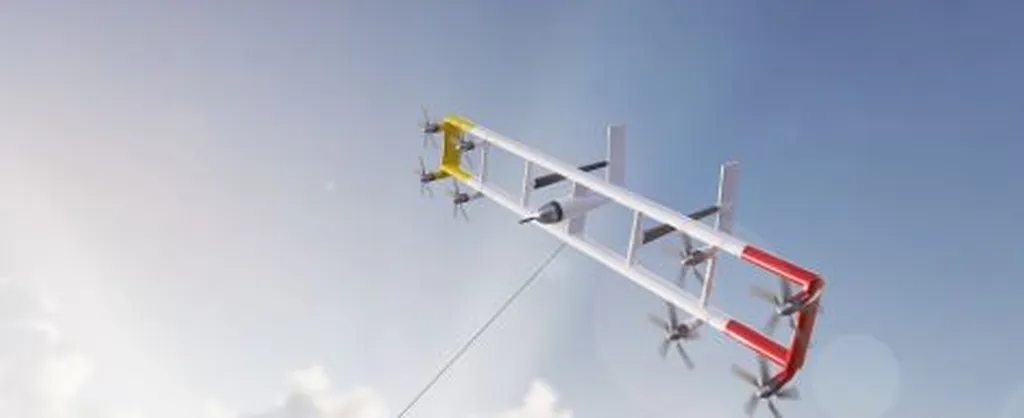
Max Beffert and Andreas Zell, researchers from the University of Tübingen in Germany, have developed new methods for real-time modeling of the aerodynamics of tethered unmanned aerial vehicles (UAVs), or drones. Their work, published in the journal “IEEE Robotics and Automation Letters,” aims to address the challenge of limited flight time for multirotor UAVs by enabling them to be powered from the ground via a tether. This could have significant implications for the energy sector, particularly in applications requiring continuous aerial monitoring or inspection.
The researchers propose two complementary approaches for real-time quasi-static tether modeling that includes aerodynamic effects. The first is an analytical method based on catenary theory, which assumes a uniform drag force along the tether. This method is notably fast, with solve times below 1 millisecond, making it highly efficient for real-time applications. The second approach is a numerical method that discretizes the tether into segments and lumped masses, solving the equilibrium equations using optimization tools called CasADi and IPOPT. By using initialization strategies like warm starting and analytical initialization, the researchers achieved real-time performance with a solve time of 5 milliseconds. This method offers more flexibility and physical accuracy when needed.
Both methods were validated through real-world tests using a load cell to measure the tether force. The results showed that the analytical method provides sufficient accuracy for most tethered UAV applications with minimal computational cost. The numerical method, while slightly more computationally intensive, offers higher flexibility and physical accuracy when required. These approaches form a lightweight and extensible framework for real-time tether simulation, applicable to both offline optimization and online tasks such as simulation, control, and trajectory planning.
For the energy sector, these advancements could enable more efficient and reliable use of tethered drones for tasks such as inspecting power lines, wind turbines, and other infrastructure. By providing a continuous power supply, tethered drones can operate for extended periods without the need for frequent battery changes or recharging, reducing downtime and increasing productivity. Additionally, the real-time modeling capabilities could enhance the safety and precision of drone operations in challenging environments, such as strong wind conditions or fast-moving base vehicles.
In summary, Beffert and Zell’s research offers practical solutions for improving the performance and versatility of tethered UAVs, with significant potential benefits for the energy industry. Their work highlights the importance of real-time modeling and simulation in advancing the capabilities of aerial technologies for various applications.
This article is based on research available at arXiv.