
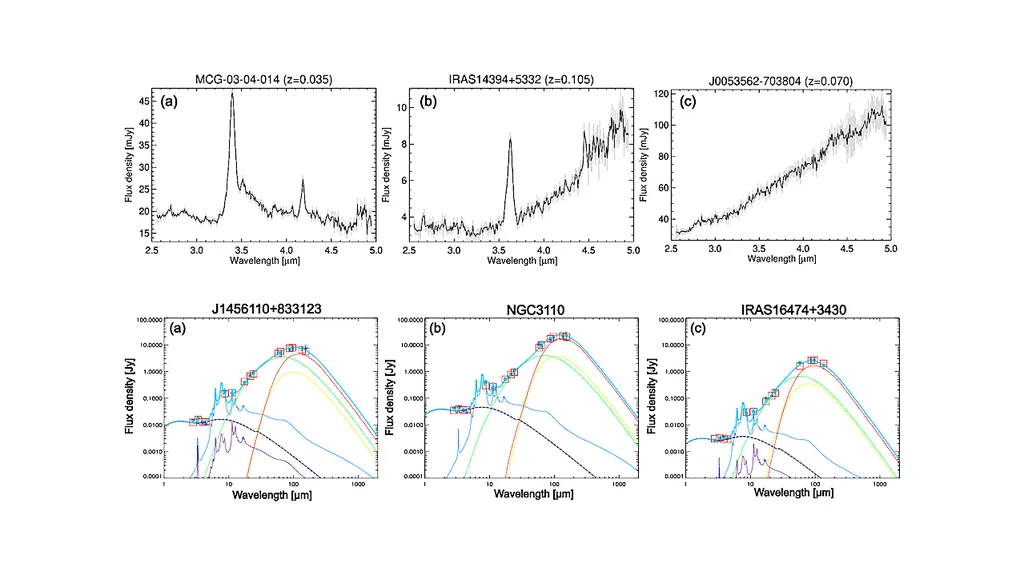
In a recent study, a team of researchers from Nagoya University, led by Tsubasa Kondo, has investigated the processing of hydrocarbon dust in various galaxies using near-infrared (IR) spectral data from the AKARI space telescope. Their findings, published in the Astrophysical Journal, provide insights into the variations of hydrocarbon emissions in different galactic environments, which could have implications for understanding the energy dynamics in the universe.
The researchers analyzed near-IR spectra of 240 star-forming (ultra-)luminous infrared galaxies ((U)LIRGs), 105 star-forming infrared galaxies (IRGs), and 65 sub-IRGs, along with 36 Galactic HII regions as a reference sample. They focused on the emission features of aromatic and aliphatic hydrocarbons, which are believed to be processed by factors such as UV radiation fields and mechanical shocks in galactic environments.
The study found that the luminosity ratios of aliphatic to aromatic hydrocarbons (Lali/Laro) in the sample galaxies showed considerable variations compared to those in the Galactic HII regions. The researchers observed that Lali/Laro systematically decreased with the total IR luminosity (LIR) and the HI recombination line Brα. This suggests that the processing of hydrocarbon dust is influenced by the energy output and the radiation environment of the galaxies.
Furthermore, the researchers noted that (sub-)IRGs with bluer continuum colors at 4 um tended to have higher Lali/Laro. This is likely because the polycyclic aromatic hydrocarbons (PAHs) in these regions remain non-processed by strong UV radiation fields, reflecting their intrinsic nature outside the HII regions. On the other hand, some ULIRGs with redder continuum colors at 4 um showed extremely low Lali/Laro, which could be due to the blending of aliphatic emission and absorption features caused by the presence of an obscured galactic nucleus in merger systems.
The practical applications of this research for the energy sector are primarily related to understanding the energy dynamics and processing of hydrocarbon dust in various galactic environments. This knowledge can contribute to the broader understanding of energy distribution and transformation in the universe, which may have implications for energy research and technology development on Earth. Additionally, the study highlights the importance of considering the radiation environment and energy output of galaxies when studying the processing of hydrocarbons, which could inform energy-related research in astrophysics and beyond.
Source: Astrophysical Journal
This article is based on research available at arXiv.