
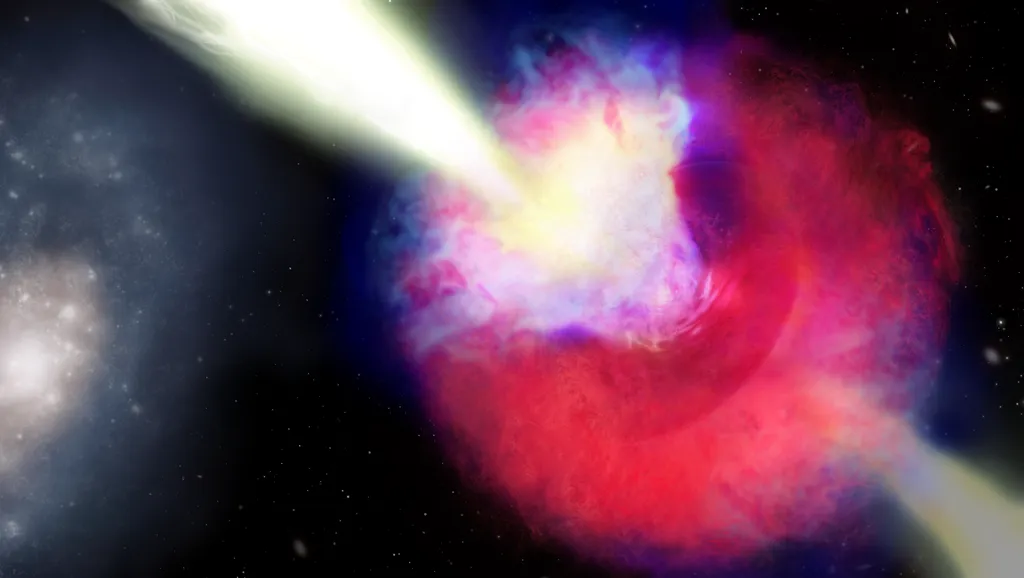
Researchers from the Nuclear physics and Multi-Messenger Astrophysics (NMMA) collaboration, led by P. Singh and including scientists from various institutions, have conducted a study to better understand the origins and properties of certain cosmic events known as merger-driven gamma-ray bursts (GRBs). Their work, published in the journal Astronomy & Astrophysics, offers insights that could have implications for our understanding of the universe and potentially the energy sector.
Gamma-ray bursts are intense explosions of energy that can last from milliseconds to several minutes. They are often followed by a kilonova, a transient astronomical event that occurs when two compact objects, like neutron stars, merge. These events are of interest to astrophysicists and energy researchers alike, as they can provide insights into the fundamental workings of the universe and potentially offer new energy sources or technologies.
The NMMA collaboration focused on modeling the afterglow and kilonova emissions from a sample of GRBs with robust redshift measurements. They used a combination of the radiative transfer code POSSIS for kilonova modeling and the afterglowpy library for afterglow modeling. Unlike previous studies, their methodology simultaneously modeled both afterglow and kilonova emissions, providing a more comprehensive understanding of these events.
Their analysis revealed that all GRBs in their sample had a kilonova, although they were unable to confirm or exclude its presence in GRB 150101B. For some GRBs, a binary neutron star (BNS) progenitor was favored, while for others, a neutron star-black hole (NSBH) scenario was slightly preferred but not conclusive. The study also found that the median wind mass from the kilonova was larger than the dynamical mass and that the wind mass and the beaming-corrected kinetic energy of the jet were correlated.
The researchers confirmed previous numerical simulations that showed the tidal deformability parameter increases with a decrease in the chirp mass. This finding could have implications for understanding the properties of neutron stars and the dynamics of their mergers.
For the energy sector, this research contributes to our broader understanding of cosmic events that release enormous amounts of energy. While it’s still far from practical applications, studying these phenomena can inspire new ideas for energy generation or technological advancements. For instance, understanding the mechanisms behind these intense energy releases could one day inform the development of novel energy technologies or improve our understanding of nuclear fusion processes. However, it’s important to note that these are long-term possibilities, and much more research is needed before any practical applications can be realized.
In conclusion, the NMMA collaboration’s work demonstrates the effectiveness of electromagnetic modeling in probing the progenitors of merger-driven GRBs. Their findings offer valuable insights into the properties of these cosmic events and contribute to our broader understanding of the universe. As we continue to explore these phenomena, we may uncover new opportunities for innovation and discovery in the energy sector.
This article is based on research available at arXiv.