
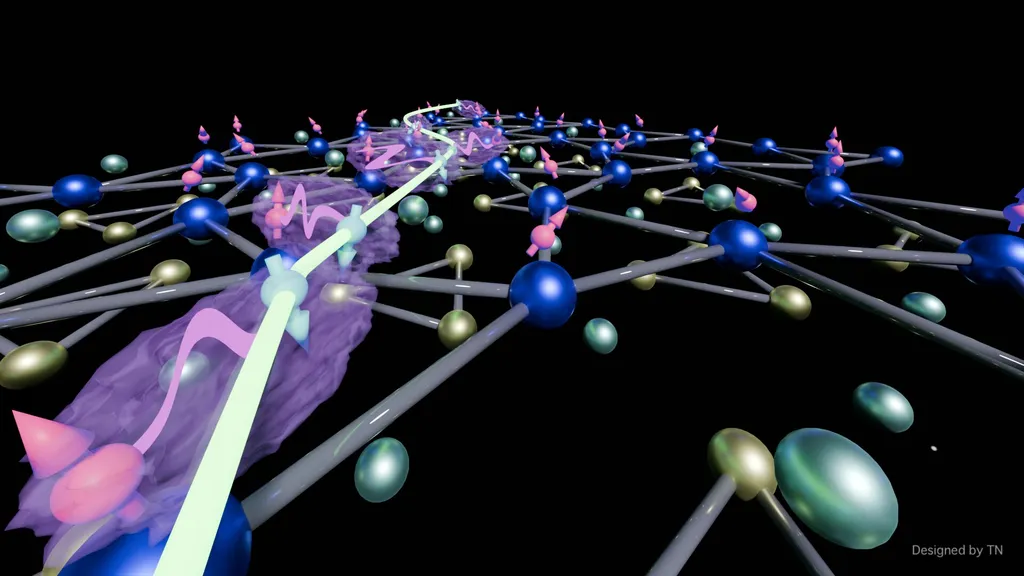
Researchers Igor Ermakov and Oleg Lychkovskiy from the University of Michigan have developed a new computational method to study the behavior of strongly correlated fermions in various dimensions. Their work, published in the journal Physical Review Letters, focuses on understanding the dynamics of these particles, which are crucial in many energy-related materials and processes.
The researchers presented a symbolic implementation of a recursion method to analyze the dynamics of strongly correlated fermions on one-, two-, and three-dimensional lattices. They focused on two key models: interacting spinless fermions and the Hubbard model, which is widely used to describe electron behavior in materials. Their findings confirm the universal operator growth hypothesis, which predicts a linear growth of certain coefficients in these systems.
By using symbolic computation to determine these coefficients and understanding their long-term behavior, the researchers were able to calculate infinite-temperature autocorrelation functions. These functions are essential for understanding how systems evolve over time and reach thermal equilibrium. Importantly, this knowledge allows for the determination of transport properties, which are critical for many energy applications.
One of the most significant findings was the precise calculation of the charge diffusion constant over a wide range of interaction strengths. Surprisingly, the results showed that this constant follows a simple functional dependence, inversely proportional to the square of the interaction strength. This relationship holds true for both small and large interaction strengths, providing a universal description of the system’s behavior.
The researchers emphasize the potential of symbolic computational methods, where the most computationally intensive step is performed once, generating symbolic results that can be reused to easily compute physical quantities for specific model parameters. This approach not only saves computational resources but also provides high-precision results directly in the thermodynamic limit, which is crucial for understanding real-world systems.
The practical applications of this research for the energy sector are significant. Understanding the transport properties of strongly correlated fermions can lead to the development of more efficient materials for energy storage, conversion, and transmission. For example, improving the diffusion of charges in battery materials can enhance their performance and longevity. Additionally, insights into the behavior of electrons in materials can aid in the design of more efficient solar cells and other energy technologies.
In summary, Ermakov and Lychkovskiy’s work provides a powerful new tool for studying the dynamics of strongly correlated fermions, with important implications for the energy industry. Their findings highlight the potential of symbolic computation methods to advance our understanding of complex systems and develop innovative energy solutions.
This article is based on research available at arXiv.