
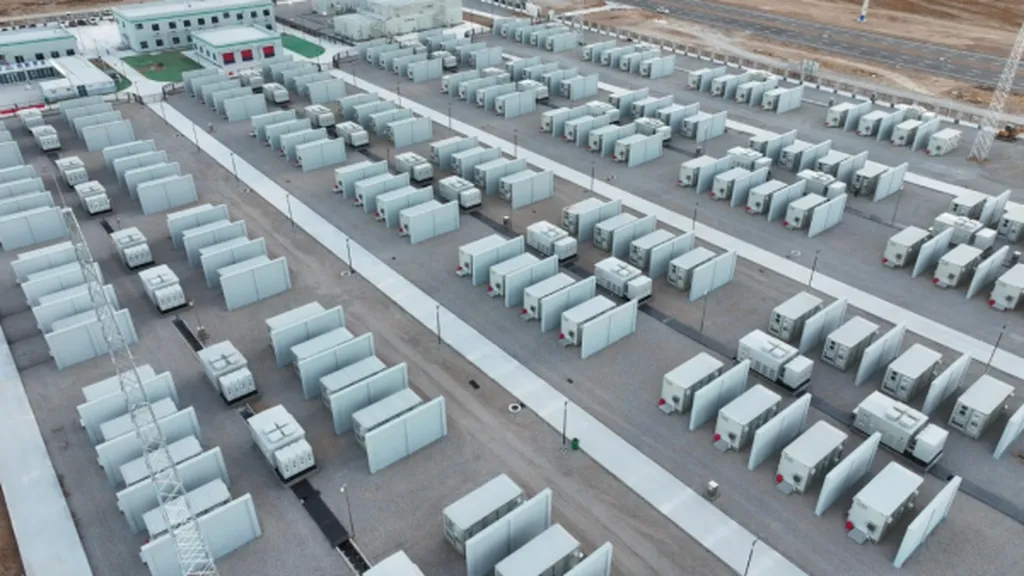
The energy storage landscape has just witnessed a watershed moment: on November 30, 2025, China Green Development successfully connected a 200 MW/800 MWh semi-solid-state battery energy storage power station to the grid in Wuhai, Inner Mongolia. This landmark project, the first of its kind at this scale, marks a decisive step toward commercializing next-generation battery technology for grid applications, offering a tantalizing glimpse into the future of renewable energy integration and grid stability.
Semi-solid-state batteries bridge the gap between conventional lithium-ion and fully solid-state designs, combining the high energy density and safety advantages of solid electrolytes with the manufacturability and cost-effectiveness of liquid-based systems. The Wuhai station’s deployment demonstrates the technology’s readiness to address two of the most pressing challenges in energy storage: scalability and longevity. Unlike traditional lithium-ion batteries, which degrade significantly over 2,000–3,000 cycles, semi-solid-state cells promise extended cycle life and reduced risk of thermal runaway—a critical factor for large-scale, long-duration storage.
“This project is not just about capacity; it’s about proving that semi-solid-state technology can deliver on its promises of safety, efficiency, and reliability at grid scale,” said a spokesperson for China Green Development. “We’re setting a new benchmark for what’s possible in energy storage, especially as renewables become a larger share of the energy mix.”
The technical breakthroughs underpinning this achievement are multifaceted. Innovations in cathode materials—such as ultra-high nickel and lithium-rich manganese-based compositions—have enabled higher energy densities and improved stability. Anode advancements, particularly in silicon-based and composite lithium metal designs, further enhance performance and reduce costs. These materials, now being produced at scale by companies like Easpring Technology and Ronbay, are pivotal in pushing semi-solid-state batteries from lab prototypes to real-world deployment.
For policymakers and industry leaders, the Wuhai station’s success underscores the urgency of accelerating investment in advanced energy storage. As global demand for lithium-ion batteries continues to surge, semi-solid-state and fully solid-state technologies offer a pathway to mitigate supply chain risks, improve energy security, and achieve climate goals. With projections indicating that solid-state battery penetration could reach 4% by 2030 and 10% by 2035, the race is on to scale production and integrate these systems into grids worldwide.
This milestone is more than a technical triumph—it’s a clarion call for the energy sector to embrace innovation, rethink infrastructure, and commit to the bold transitions required for a sustainable future. The grid of tomorrow will be built on the storage solutions we pioneer today.