
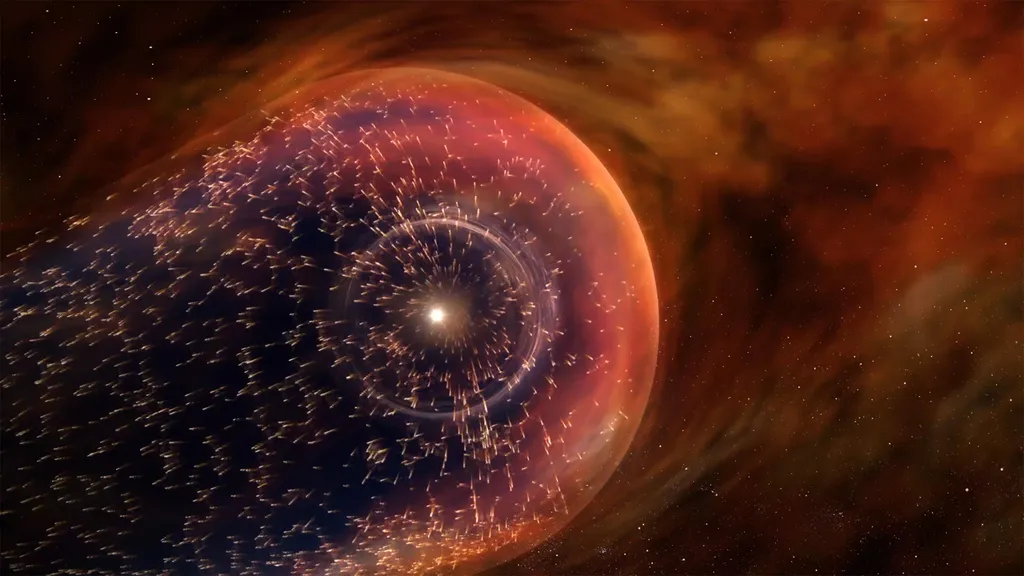
In the realm of space physics and energy research, a trio of scientists from Boston University, Sergey D. Korolkov, Igor I. Baliukin, and Merav Opher, have been delving into the mysteries of our heliosphere, the vast bubble-like region of space dominated by the Sun’s influence. Their recent work, published in the Journal of Geophysical Research: Space Physics, sheds light on a longstanding discrepancy between models and observations of the magnetic field in the inner heliosheath, a region between the termination shock and the heliopause.
The heliosphere is a dynamic and complex system, shaped by the solar wind and the interstellar medium. Global models of the heliosphere typically predict a significant increase in the magnetic field strength in the inner heliosheath, a phenomenon known as magnetic field pile-up. However, data from the Voyager 1 and 2 spacecraft, which have ventured into this region, show only a gradual increase. This mismatch has puzzled scientists for years.
The researchers identified that the simplified assumption of a unipolar solar magnetic field in many global models is a key factor in this discrepancy. In reality, the solar magnetic field is much more complex, with a folded structure known as the heliospheric current sheet (HCS). This sheet is a prime location for magnetic dissipation via reconnection, a process that converts magnetic energy into thermal energy.
To reconcile the models with observations without resorting to computationally expensive methods, the team introduced a phenomenological term into the magnetic field induction equation. This term captures the macroscopic effect of magnetic energy dissipation due to the unresolved dynamics of the HCS. The term is designed to mitigate the artificial magnetic pile-up, preserve the topological integrity of the magnetic field lines, and avoid explicit magnetic diffusion.
The study demonstrated that incorporating this phenomenological dissipation term into global heliospheric models significantly improves the agreement with Voyager measurements. It reduces the exaggerated magnetic energy, aligns the model output with the observed magnetic field and proton density profiles, and produces an outward shift in the termination shock position and a reduction of the inner heliosheath thickness. The researchers found that a characteristic time for magnetic field dissipation of about 6 years provides the best agreement with Voyager data.
This research has practical implications for the energy sector, particularly in the field of space weather prediction. Accurate models of the heliosphere are crucial for understanding and predicting the behavior of solar energetic particles, which can impact space-based and ground-based technologies. By improving the alignment of models with observations, this work contributes to enhancing our predictive capabilities and mitigating potential risks to energy infrastructure.
In conclusion, the study by Korolkov, Baliukin, and Opher represents a significant step forward in our understanding of the heliosphere. By addressing a longstanding discrepancy between models and observations, their work paves the way for more accurate predictions of space weather and its potential impacts on the energy sector.
This article is based on research available at arXiv.