
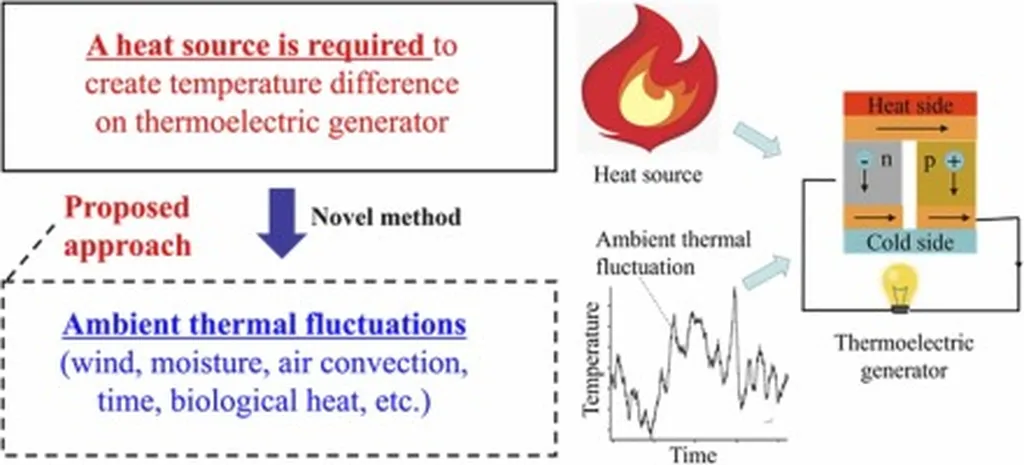
In the realm of energy research, a team of scientists from the University of Seville in Spain and the University of Arkansas in the United States has been exploring innovative methods to harvest energy from thermal fluctuations. The researchers, L. L. Bonilla, A. Torrente, J. M. Mangum, and P. M. Thibado, have recently published their findings in a two-part series in the Journal of Physics A: Mathematical and Theoretical.
The researchers investigated an energy harvesting system that includes a small variable capacitor, such as free-standing graphene, connected to two diodes and two storage capacitors. This setup can be maintained at different temperatures or a single temperature and utilizes two current loops. The system quickly reaches a quasi-stationary state where the overall charge remains constant, while the difference in charges between the storage capacitors evolves more slowly to its stationary value.
The study focuses on extracting an exponentially small factor from the solution of the Fokker-Planck equation, which describes the time evolution of the probability density of the system’s state. By employing a Chapman-Enskog procedure, the researchers were able to describe the long-term evolution of the marginal probability density for the charge difference. This evolution transitions from the quasi-stationary state to the final stationary state, which is essentially thermal equilibrium when the temperatures are equal.
In the second part of their series, the researchers validated their theoretical findings with direct numerical simulations. They also demonstrated that for a specific form of the diodes’ nonlinear mobilities, the quasi-stationary state can be approximated by Gaussian functions. This approximation allowed them to further study the evolution of the marginal probability density, which adopts the shape of a slowly expanding pulse in the space of charge differences. This pulse comprises left and right-moving wave fronts whose leading edges become sharper as time progresses, ultimately leaving the final stationary state behind.
The practical applications of this research for the energy sector could be significant. By understanding and harnessing thermal fluctuations, this system could potentially contribute to more efficient energy harvesting methods. This could be particularly useful in environments where temperature differences are prevalent, such as industrial settings or geothermal sites. Additionally, the use of graphene as a variable capacitor highlights the potential for advanced materials to play a crucial role in future energy technologies.
This article is based on research available at arXiv.