
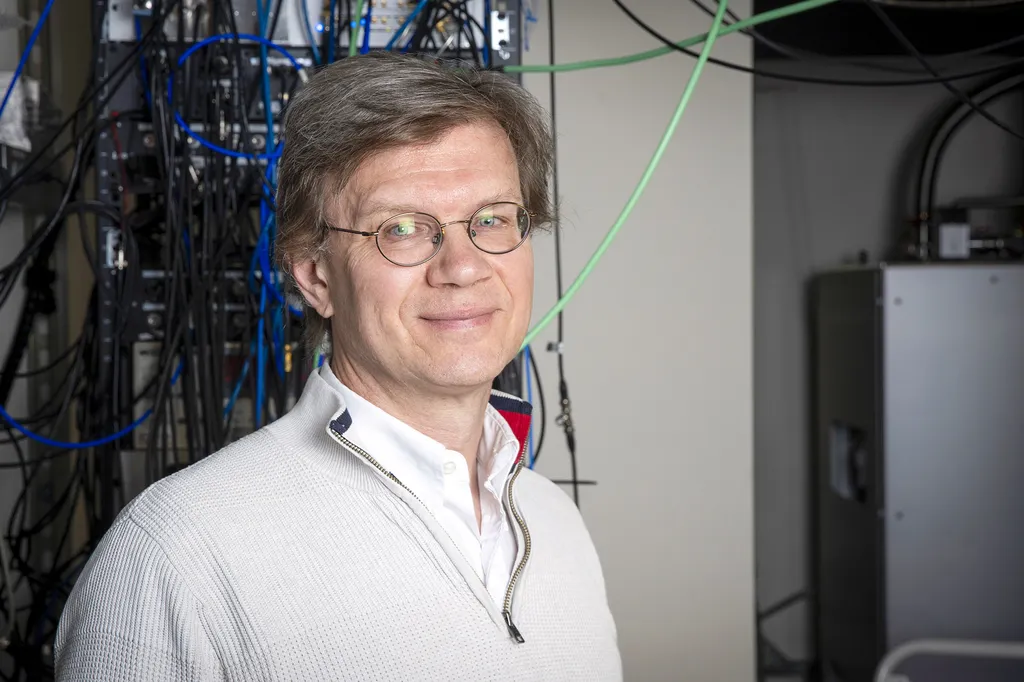
In the realm of quantum computing, a team of researchers from the University of California, Santa Barbara, and the University of Texas at Austin, led by Vlad Temkin, has made significant strides in understanding and improving quantum error correction. Their work, titled “Charge-Informed Quantum Error Correction,” delves into the statistical physics of error correction in a specific type of quantum memory known as U(1) symmetry-enriched topological quantum memories.
The researchers investigated a phenomenological error model where noise conserves charge, a property of certain quantum systems. They studied the optimal decoder, assuming that the local charges of each anyon—a type of quasi-particle in topological quantum systems—can be measured. The error threshold of this optimal decoder corresponds to a continuous phase transition in a disordered two-dimensional integer loop model on the Nishimori line, a concept from statistical physics.
Using effective replica field theory analysis and Monte Carlo numerics, the team demonstrated that the optimal decoding transition exhibits Berezinskii-Kosterlitz-Thouless (BKT) universality. This is a type of phase transition characterized by the unbinding of vortex-antivortex pairs. Notably, they found a modified universal jump in winding number variance, a measure of the system’s disorder.
The researchers also generalized the model beyond the Nishimori line, defining a large class of suboptimal decoders. At low, nonzero temperatures and strong disorder, they discovered numerical evidence of a disorder-dominated loop-glass phase. This phase corresponds to a “confidently incorrect” decoder, which, despite its confidence, makes incorrect error corrections. The zero-temperature limit of this model defines the minimum-cost flow decoder, analogous to the minimum-weight perfect matching in Z2 topological codes.
Both the optimal and minimum-cost flow decoders were shown to dramatically outperform the charge-agnostic optimal decoder in symmetry-enriched topological codes. This means that by considering the charge information, the decoders can correct errors more effectively.
The practical applications of this research for the energy sector, particularly in quantum energy technologies, are promising. Quantum computing has the potential to revolutionize energy systems by enabling more efficient optimization of energy grids, improving energy storage solutions, and enhancing the design of new materials for renewable energy technologies. More robust quantum error correction methods, like those developed in this study, bring us closer to realizing the full potential of quantum computing in the energy sector.
This research was published in the prestigious journal Physical Review Letters, a primary journal of the American Physical Society.
This article is based on research available at arXiv.