
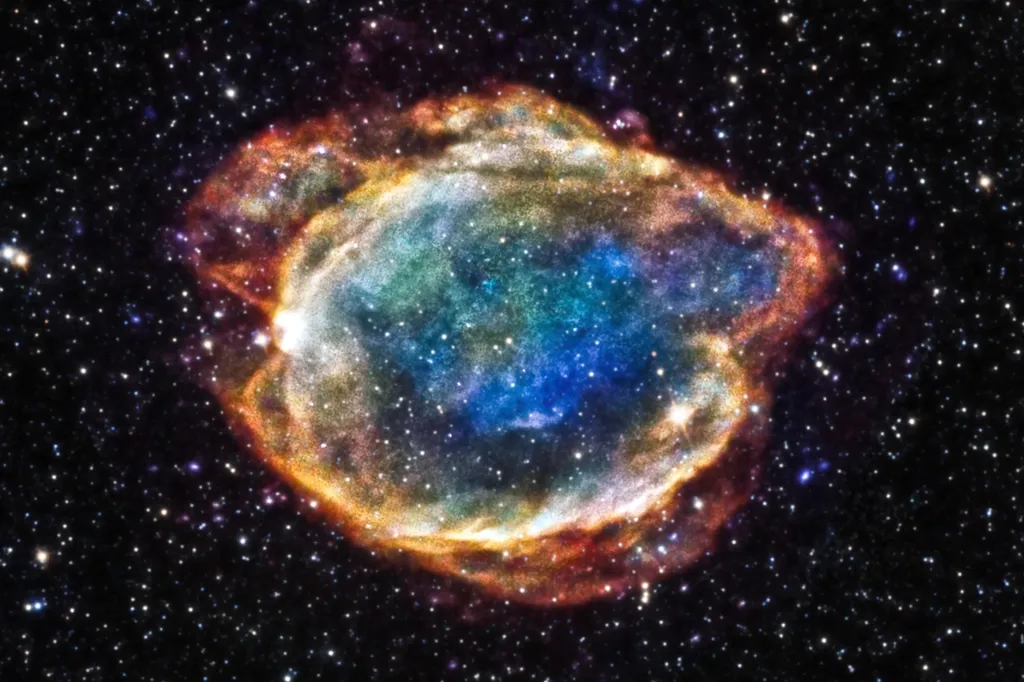
In the realm of astrophysics and energy research, a team of scientists from the National Research Nuclear University MEPhI in Moscow has made significant strides in understanding the behavior of neutrinos and antineutrinos in the late stages of a star’s life. This research, led by Alan A. Dzhioev, Andrey V. Yudin, Natalia V. Dunina-Barkovskaya, and Andrey I. Vdovin, sheds light on the potential for detecting these elusive particles before a supernova event, offering valuable insights for both scientific and practical applications.
The team utilized the stellar evolution code MESA to simulate the conditions within a star on the brink of a supernova. Their focus was on the spectra and luminosities of neutrinos and antineutrinos produced by thermal processes and nuclear weak-interaction reactions. These particles are of particular interest because they can escape from the dense core of a collapsing star, carrying valuable information about the star’s final moments.
The researchers compared two methods for predicting neutrino and antineutrino emissions: the thermal quasiparticle random-phase approximation and the standard effective Q-value method. Their findings revealed that a thermodynamically consistent treatment of Gamow-Teller transitions in hot nuclei significantly enhances both the energy luminosity and the average energies of the emitted particles. This enhancement is crucial for assessing the feasibility of detecting pre-supernova neutrinos.
For the energy sector, this research has implications for monitoring and predicting stellar events that could impact Earth’s energy systems. Neutrino detectors, for instance, could be used to provide early warnings of supernovae, allowing for better preparation and mitigation of potential effects on power grids and other energy infrastructure. Additionally, understanding the behavior of neutrinos and antineutrinos in extreme astrophysical environments can contribute to the development of advanced energy technologies, such as neutrino-based energy generation.
The research was published in the journal Physical Review C, a leading publication in the field of nuclear physics. The findings represent a significant step forward in our understanding of pre-supernova neutrino emissions and their potential applications in the energy sector. As the team continues to refine their models and simulations, the practical benefits of this research are likely to become even more apparent.
This article is based on research available at arXiv.