
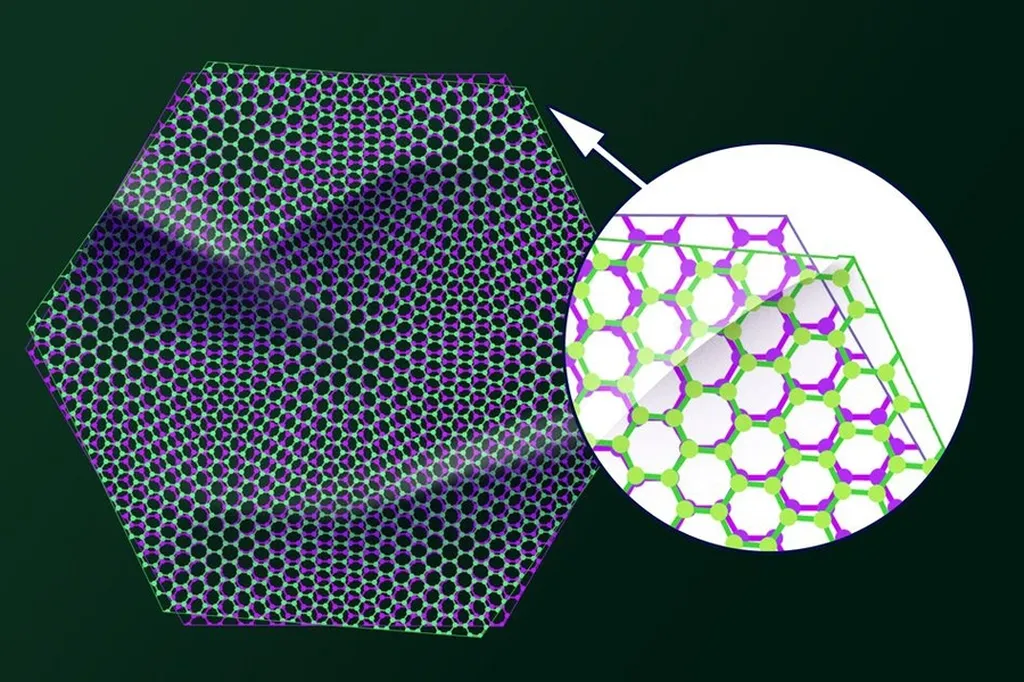
Researchers Ayoub Bahloua, Youness Zahidi, and Ahmed Naddami from the Mohammed VI Polytechnic University in Morocco have recently published a study in the journal Physical Review B that explores the quantum tunneling behavior of charge carriers in twisted bilayer graphene (TBG) superlattices. Their findings could have significant implications for the development of nanoelectronic and quantum devices in the energy sector.
The study focuses on the transmission probabilities of charge carriers through a periodic superlattice in TBG, which consists of two layers of graphene rotated relative to each other. The researchers used a low-energy continuum model to analyze how various parameters, such as twist angle, number of barriers, barrier geometry, and the presence of defects, affect the transmission of charge carriers.
The researchers found that the transmission of charge carriers is highly sensitive to these parameters. For instance, reducing the twist angle changes the number, depth, and position of transmission gaps and resonance peaks. The presence of defects also affects the transmission, leading to the appearance of tunneling states inside transmission gaps. These tunneling states can be tuned by adjusting the well width, providing a way to control the flow of charge carriers.
At low incident energy, the transmission for normally incident electrons is perfect or nearly perfect, independent of the twist angle and the number of barriers. However, at large incident energy, the transmission becomes distinctly anisotropic, reflecting the separation of Dirac cones induced by twist angle variations. The presence of defects, particularly at smaller twist angles, provides additional control of tunneling behavior, allowing complete suppression of Klein tunneling under certain conditions.
These findings extend the established understanding of miniband transport in periodic graphene systems and open new possibilities for twist-tunable nanoelectronic and quantum devices. In the energy sector, these insights could lead to the development of more efficient and controllable electronic devices, such as transistors and sensors, which are crucial for various energy applications, including renewable energy systems and energy storage technologies.
The research was published in the journal Physical Review B, a reputable source for research in condensed matter and materials physics. The study’s findings contribute to the growing body of knowledge on graphene-based materials and their potential applications in the energy sector.
This article is based on research available at arXiv.