
In the realm of energy journalism, a recent study conducted by a team of researchers from the Institute of Space and Astronautical Science (ISAS) at the Japan Aerospace Exploration Agency (JAXA) has shed light on the behavior of interstellar hydrocarbon dust, which has significant implications for our understanding of energy processes in galaxies. The team, led by Tsubasa Kondo, utilized data from the AKARI satellite’s near-infrared spectrometer to investigate the emission features of aromatic and aliphatic hydrocarbons in various galaxies.
The study focused on the luminosity ratio of aliphatic to aromatic hydrocarbon emission features, specifically at wavelengths of 3.3 micrometers and 3.4-3.6 micrometers. The researchers analyzed spectra from 240 star-forming galaxies with high infrared luminosity, 105 galaxies with moderate infrared luminosity, and 65 galaxies with lower infrared luminosity, in addition to 36 Galactic HII regions as a reference sample. The goal was to understand the factors influencing the variations in the luminosity ratio of these hydrocarbons.
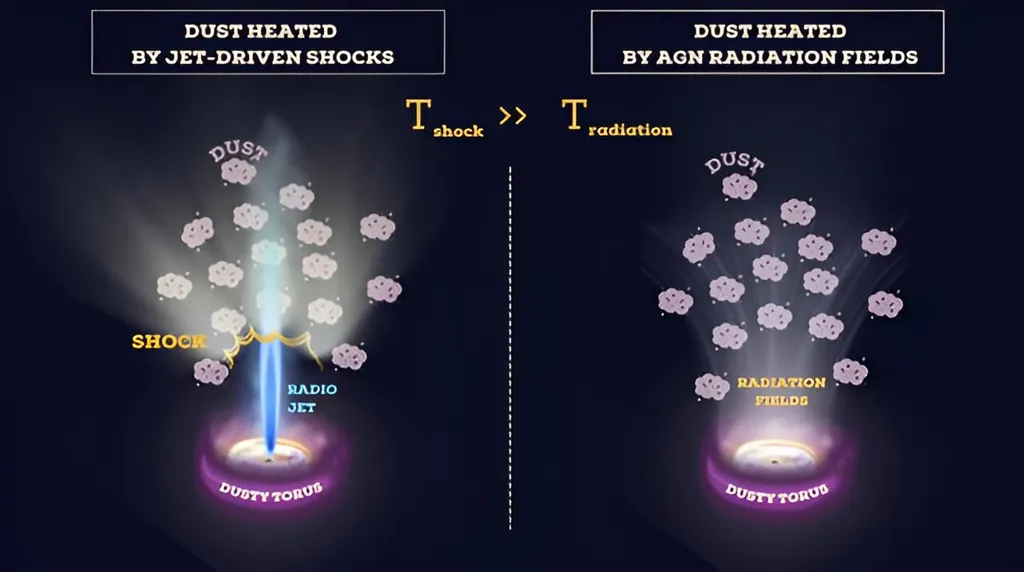
The results indicated that the luminosity ratios of aliphatic to aromatic hydrocarbons in the sample galaxies showed considerable variation compared to those in the Galactic HII regions. Notably, the ratio systematically decreased with increasing infrared luminosity and the luminosity of the hydrogen recombination line Brα. This suggests that the processing of hydrocarbon dust is influenced by the intensity of the ultraviolet radiation field and mechanical shocks within the galactic environments.
The researchers also found that galaxies with bluer continuum colors at 4 micrometers tended to have higher luminosity ratios of aliphatic to aromatic hydrocarbons. This is likely because the polycyclic aromatic hydrocarbons (PAHs) in these regions remain less processed by strong ultraviolet radiation fields, preserving their aliphatic characteristics. Conversely, some ultra-luminous infrared galaxies (ULIRGs) with redder continuum colors at 4 micrometers exhibited extremely low luminosity ratios, which could be attributed to the blending of aliphatic emission and absorption features due to the presence of an obscured galactic nucleus in merger systems.
The practical applications of this research for the energy sector are significant. Understanding the behavior of interstellar hydrocarbon dust can provide insights into the energy processes within galaxies, which in turn can inform our understanding of energy production and distribution in the universe. This knowledge can be applied to the development of more efficient energy technologies and the optimization of energy systems on Earth. The study was published in the Astrophysical Journal.
This article is based on research available at arXiv.