
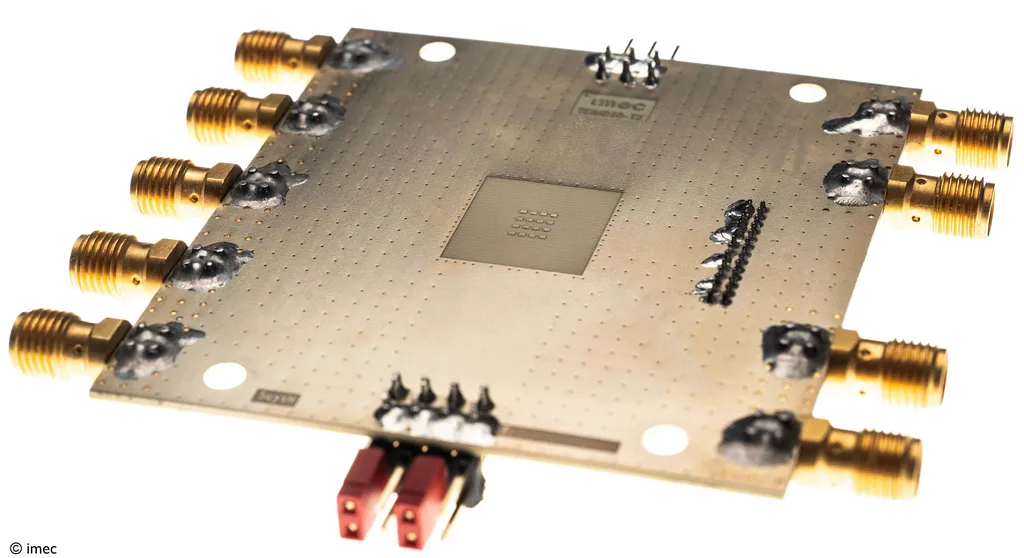
Researchers from imec, a leading international research center in nanoelectronics and digital technologies, have made significant strides in understanding the charge transport mechanism in amorphous oxide semiconductors (AOS), particularly indium gallium zinc oxide (IGZO). This team, led by Ying Zhao and including notable contributors such as Michiel J. van Setten and Ben Kaczer, has published their findings in the esteemed journal Nature Communications.
The study focuses on thin-film transistors based on IGZO, which are promising candidates for advancing DRAM scaling and 3D integration in computing technologies. Despite extensive research, the charge transport mechanism in these disordered semiconductors has remained poorly understood until now. The researchers investigated charge transport in IGZO across various compositions and temperatures using thin-film transistors and Hall bar structures.
Their findings reveal that the electrons involved in transport exhibit partial spatial coherence and non-degenerate conduction. This means that transport is dominated by electron transfer across insulating gaps between locally coherent regions, rather than by the previously assumed mechanisms of degenerate percolative transport or localized-state hopping. The researchers developed a field-effect-aware fluctuation-induced tunnelling (FEAFIT) framework to describe this behavior, which accurately predicts experimental data across all compositions, temperatures, and gate voltages.
The FEAFIT model allows for the extraction of fundamental transport parameters, which were then correlated with electron coherence dimensions and the degree of energetic disorder obtained from first-principles calculations. This research not only advances the fundamental understanding of charge transport in AOS-based transistors but also provides a foundation for further performance improvements in the energy sector, particularly in the development of more efficient and scalable electronic devices.
The practical applications of this research are significant for the energy industry. By improving the understanding and performance of thin-film transistors, the energy efficiency of electronic devices can be enhanced, leading to reduced energy consumption and lower carbon emissions. This is particularly relevant for data centers and other high-performance computing environments, where energy efficiency is a critical concern.
In summary, the research conducted by the team at imec sheds new light on the charge transport mechanism in IGZO-based thin-film transistors. Their development of the FEAFIT model and the extraction of fundamental transport parameters provide valuable insights for the energy industry, paving the way for more efficient and scalable electronic devices. The findings were published in Nature Communications, a highly respected journal in the field of scientific research.
Source: Nature Communications
This article is based on research available at arXiv.