
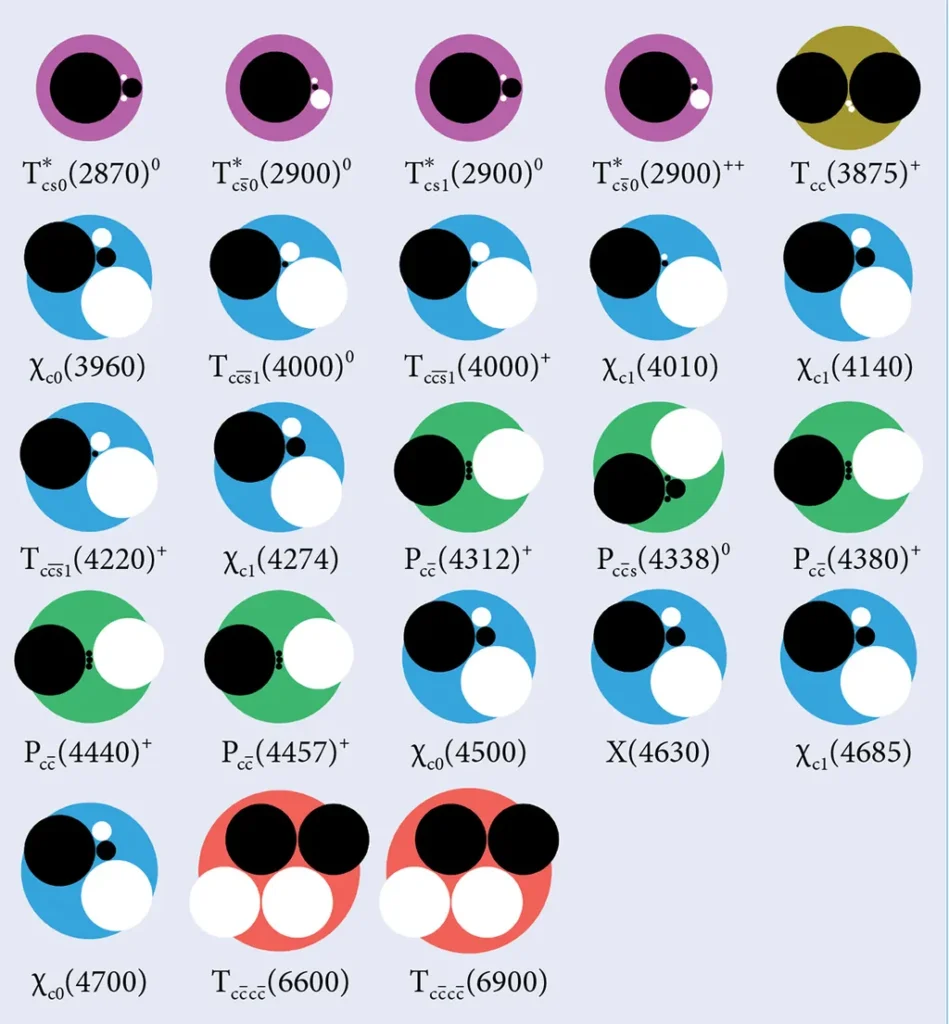
Researchers from the Institute of High Energy Physics at the Chinese Academy of Sciences have delved into the electromagnetic properties of fully charm tetraquark states, a type of exotic hadron composed of four quarks. Their work, published in the journal Physical Review D, explores the quantum chromodynamics (QCD) corrections to the decay and production processes of these particles, providing insights that could be valuable for experimental physicists in the energy sector.
The study first presents analytical expressions for the next-to-leading-order (NLO) QCD corrections to the decay amplitudes of fully charm tetraquarks into two photons. The researchers found that these corrections are significant for the decay process of fully charm tetraquarks with quantum numbers J^PC = 0^++, but relatively small for those with J^PC = 2^++. This nuanced understanding of the decay processes can help experimentalists better identify and study these particles in high-energy collisions.
Furthermore, the researchers considered the production of fully charm tetraquarks through photon-photon fusion in ultra-peripheral high-energy collisions of protons and nuclei, as well as in electron-positron collision processes. They provided theoretical predictions for the production cross sections of these exotic states, which can guide experimental searches and measurements in current and future experiments.
The practical applications of this research for the energy sector lie in the development of advanced particle detectors and the improvement of theoretical models used in high-energy physics experiments. A deeper understanding of the electromagnetic properties and production mechanisms of fully charm tetraquarks can contribute to the design and optimization of particle accelerators and detectors, which are crucial tools for both fundamental research and various energy-related applications. The results presented in this work shall be tested in current and future experiments, paving the way for further advancements in the field.
This article is based on research available at arXiv.