
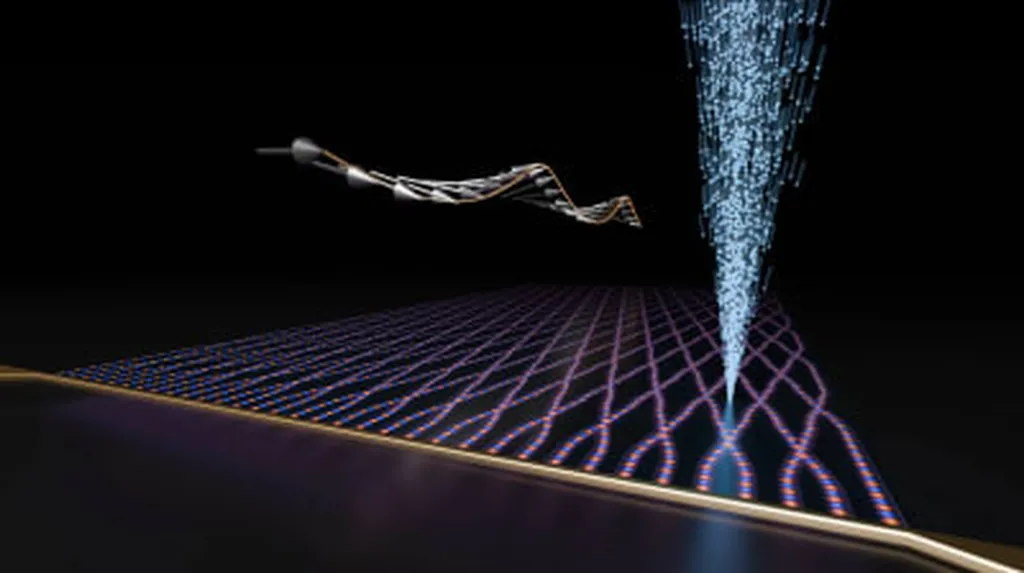
In the realm of energy and materials science, a trio of researchers from the Leibniz Institute for Solid State and Materials Research (IFW) in Dresden, Germany—Danilo Nikolić, Niklas L. Schulz, and Matthias Eschrig—have made significant strides in understanding the conditions necessary for the Josephson diode effect in magnetic materials. Their work, published in the journal Physical Review B, focuses on the interplay between superconductors and magnetic materials, which could have practical implications for energy-efficient electronic devices and quantum technologies.
The Josephson diode effect refers to a phenomenon where a supercurrent flows more easily in one direction than the other, akin to how a diode allows current to flow in only one direction in conventional electronics. This effect is particularly intriguing when it occurs in magnetic materials that are strongly spin-polarized, meaning the spins of the electrons are aligned in a particular direction.
The researchers identified several necessary conditions for the charge and spin Josephson diode effects to occur. Firstly, the spin texture of the magnetic material must be noncoplanar, breaking the spatial inversion symmetry. This noncoplanarity gives rise to quantum geometric phases that influence the Josephson current-phase relation (CPR). Secondly, both spin bands of the material must contribute to the transport, meaning the effect is absent in half-metallic junctions where only one spin band is conducting. Thirdly, the material must have different band-specific densities of states, a condition ensured by the strong spin polarization of the magnetic material. Lastly, higher harmonics in the CPR are necessary, indicating that the effect is absent in the tunneling limit where only the first harmonic is present.
The researchers also formulated a minimal phenomenological model that incorporates all these conditions, providing a qualitative illustration of their theory. This model helps to understand how the quantum geometric phases enter the CPR and result in the Josephson diode effect.
The practical applications of this research for the energy sector are promising. Understanding and controlling the Josephson diode effect in magnetic materials could lead to the development of more energy-efficient electronic devices, such as superconducting diodes and transistors. These devices could operate with minimal energy loss, contributing to more sustainable energy technologies. Additionally, the insights gained from this research could be applied to quantum computing and other advanced technologies that rely on the precise control of electron spins.
In summary, the work of Nikolić, Schulz, and Eschrig provides a comprehensive set of conditions for the Josephson diode effect in magnetic materials, offering valuable insights for the development of next-generation energy-efficient devices and quantum technologies. Their findings, published in Physical Review B, represent a significant step forward in the field of condensed matter physics and materials science.
This article is based on research available at arXiv.