
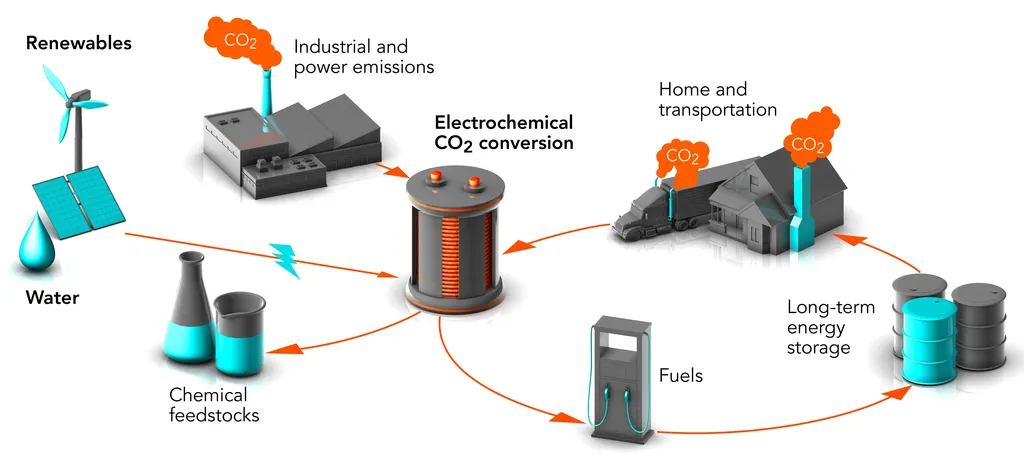
Researchers Federico J. Gonzalez, Carmen A. Tachino, and H. Fabio Busnengo from the National University of Córdoba in Argentina have published a study in the Journal of Physical Chemistry C that sheds light on the dissociation of carbon dioxide (CO2) on copper surfaces, a process relevant to energy conversion and storage technologies.
The study focuses on the interaction of CO2 molecules with a specific copper surface, Cu(110), using advanced computational methods. The researchers employed density functional theory calculations with a specialized exchange-correlation functional (vdW-DF2) to understand the potential energy surface of the reaction. They then parameterized this surface using artificial neural networks to simulate the behavior of CO2 molecules as they approach and interact with the copper surface.
The team performed quasi-classical trajectory calculations to determine the probabilities of molecular and dissociative adsorption as functions of the initial impact energy of the CO2 molecules and the surface temperature. Their results align well with experimental data obtained from supersonic molecular beam experiments at normal incidence. The study found that the probability of CO2 dissociation on the copper surface is largely independent of surface temperature between 50 and 400 K, provided the impact energy is sufficiently high.
One of the most intriguing findings of the research is the significant surface distortions induced by the dissociation of high-energy CO2 molecules at and above room temperature. These distortions include the creation of copper adatoms and vacancy-adatom pairs, which are influenced by the presence of adsorbed CO and O atoms. The researchers observed unexpected linear moieties involving a copper adatom almost detached from the surface, anchored by a dissociated oxygen atom. These findings suggest that high-energy CO2 molecules can lead to greater oxygen coverage on the copper surface, which has implications for energy conversion processes.
The practical applications of this research for the energy sector are significant. Understanding the dissociation of CO2 on copper surfaces can help in the development of more efficient catalysts for energy conversion and storage technologies, such as fuel cells and electrochemical devices. The insights gained from this study can guide the design of better materials and processes for capturing and utilizing CO2, contributing to a more sustainable energy future.
This article is based on research available at arXiv.