
In the realm of energy data analysis and grid management, efficient graph processing is crucial for optimizing complex networks. Researchers Deniz Elbek and Kamer Kaya from the University of California, Santa Barbara, have developed a novel approach to accelerate a fundamental graph algorithm, Breadth-First Search (BFS), using the specialized Tensor Cores found in modern GPUs. Their work, titled “BLEST: Blazingly Efficient BFS using Tensor Cores,” presents a significant advancement in graph processing that could have practical applications in the energy sector.
Breadth-First Search is a fundamental graph algorithm used in various applications, including network analysis, pathfinding, and cybersecurity. While modern GPUs offer high-throughput Matrix-Multiply-Accumulate (MMA) units, such as Tensor Cores (TC), these units are designed for dense operations, making it challenging to leverage them for irregular, unstructured graph computations like BFS. The researchers addressed this challenge by developing BLEST, a TC-accelerated framework that reformulates the pull-based BFS pipeline around a bitmap-oriented structure and a carefully engineered execution layout.
BLEST introduces several innovations to improve the efficiency of BFS on GPUs. One key advancement is the use of Binarised Virtual Slice Sets (BVSS) to enforce warp-level load balancing and eliminate frontier-oblivious work assignment. This ensures that the computational workload is evenly distributed across the GPU’s processing units, maximizing efficiency. Additionally, the researchers applied two complementary graph reordering strategies to enhance memory efficiency and update locality across diverse graphs. A compression-oriented ordering is used for social-like graphs, while a bandwidth-reducing ordering is employed for non-social graphs.
At the compute level, BLEST employs a batched SpMSpV multiplication pattern that utilizes the bitwise TC tiles to handle dot products without wasting output entries. This approach reduces the number of required MMA calls, further improving performance. The framework also combines kernel fusion with a lazy vertex update scheme to reduce host-side synchronization, mitigate atomic overheads, and improve cache locality.
Experiments conducted by the researchers demonstrated that BLEST delivers significant speedups over existing state-of-the-art methods. On average, BLEST achieved 3.58 times, 4.64 times, and 4.9 times speedup over BerryBees, Gunrock, and GSWITCH, respectively, across a broad set of real-world graphs. These results highlight the potential of BLEST to revolutionize graph processing in various industries, including the energy sector.
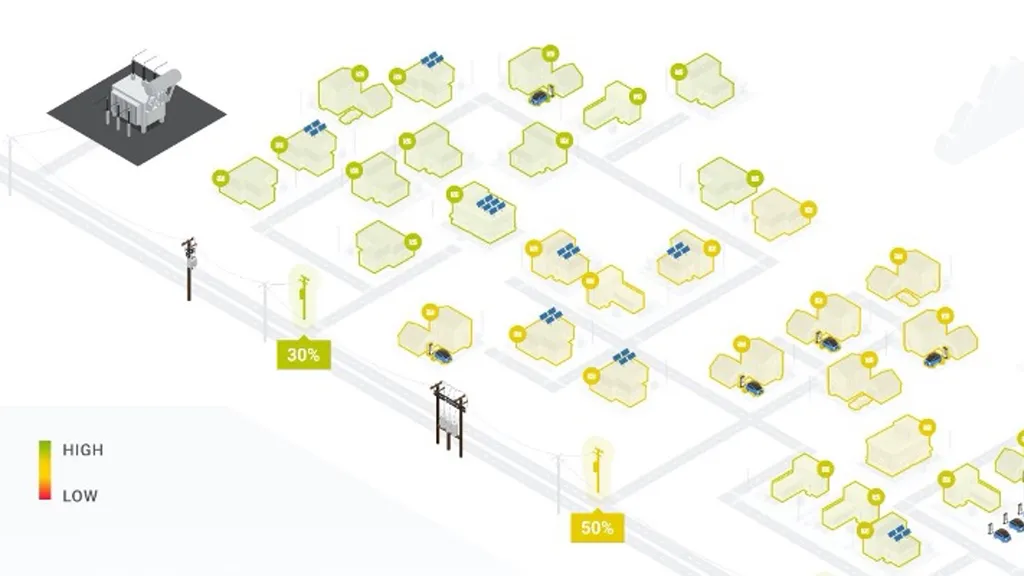
In the energy industry, efficient graph processing is essential for analyzing and optimizing complex networks such as power grids, distribution systems, and smart meters. The ability to quickly and accurately perform BFS and other graph algorithms can enhance grid management, improve fault detection and recovery, and optimize energy distribution. By leveraging the advancements presented in BLEST, energy companies can potentially improve the efficiency and reliability of their operations, ultimately leading to a more robust and sustainable energy infrastructure.
The research was published in the Proceedings of the ACM on Measurement and Evaluation of Computing Systems (ACM TOMACS).
This article is based on research available at arXiv.