
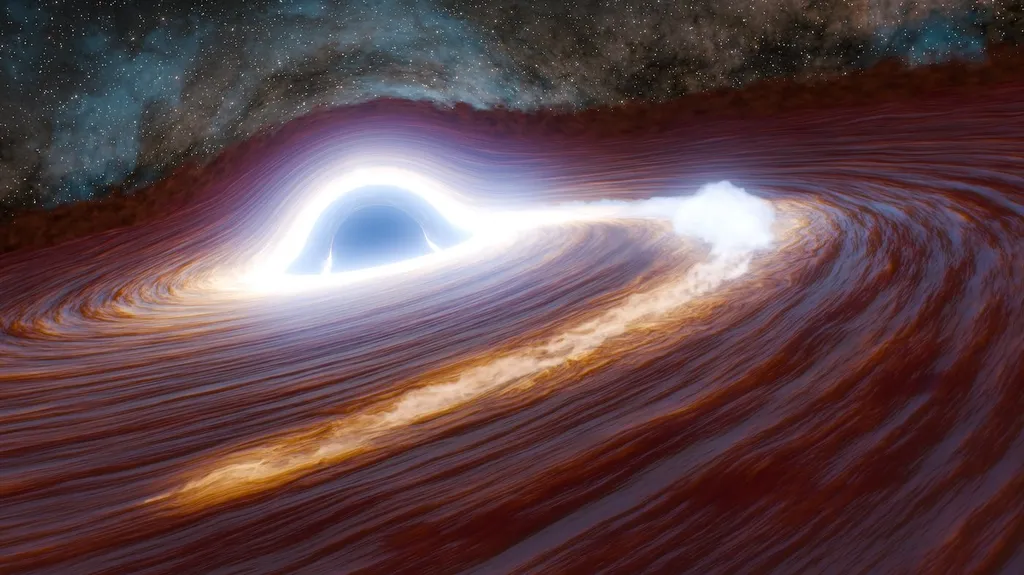
In the realm of energy and astrophysics, a recent study led by Tatsuya Matsumoto from the Academia Sinica Institute of Astronomy and Astrophysics in Taiwan, has shed light on the enigmatic late-time radio flares observed in tidal disruption events (TDEs). These events occur when a star ventures too close to a supermassive black hole and is torn apart by the black hole’s tidal forces. The study, published in the Monthly Notices of the Royal Astronomical Society, explores two leading scenarios to explain these radio flares and proposes a method to distinguish between them.
The two scenarios under investigation are a delayed outflow launched around 1000 days after the discovery of the TDE, and an off-axis relativistic jet directed far from our line of sight. To differentiate between these models, Matsumoto and his team employed very long baseline interferometry (VLBI) imaging, a technique that combines signals from multiple radio telescopes to achieve extremely high resolution.
The researchers calculated synthetic radio images for both the delayed-outflow and off-axis jet scenarios and examined their observational signatures. They found that the motion of the emission centroid, or the point where the emission is brightest, is the most powerful diagnostic for distinguishing between the two models. In the delayed-outflow scenario, the centroid motion is confined within a non-relativistic distance, meaning it moves slower than the speed of light. However, in the off-axis jet scenario, the centroid exhibits apparent superluminal motion, appearing to move faster than the speed of light due to relativistic effects.
Detecting such superluminal motion would provide a smoking-gun signature of the off-axis jet interpretation. Additionally, the study found that the jet image exhibits characteristic features, including a non-monotonic evolution of the image aspect ratio, which could further help in identifying the presence of an off-axis jet.
The findings of this study are expected to be generic and applicable to other jetted explosions, such as microquasars and gamma-ray bursts. In the energy sector, understanding the behavior of relativistic jets can have implications for the study of high-energy astrophysical processes and the development of advanced energy technologies inspired by these natural phenomena. For instance, the study of relativistic jets can contribute to the development of advanced propulsion systems and energy generation methods that harness the power of these extreme astrophysical environments.
This article is based on research available at arXiv.