
Researchers from the University of Science and Technology of China, led by Yu-Heng Sheng, have recently published a study in the Astrophysical Journal that sheds light on the behavior of matter around black holes in the early universe. The team, including De-Fu Bu, Xiao-Hong Yang, Yi-Ren Chang, and Liang Chen, focused on a phenomenon called Tidal Disruption Events (TDEs), where a star is torn apart by the gravitational forces of a black hole. Their work specifically looked at TDEs involving Population III stars, which are the first generation of stars born in the universe.
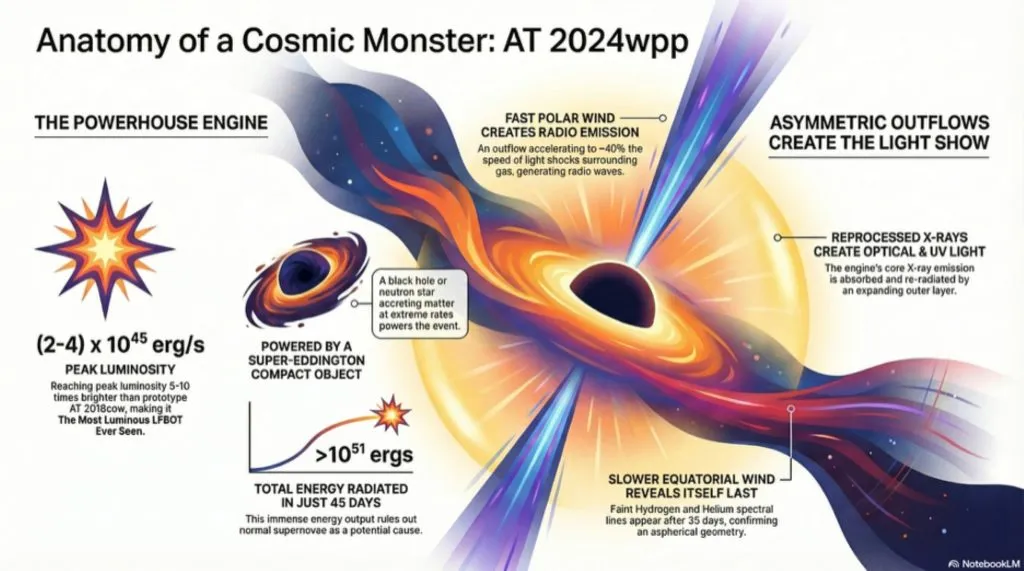
The researchers used advanced computer simulations to model the behavior of matter as it spirals into a black hole during a TDE. They found that the black hole’s growth rate was extremely high, far exceeding the theoretical maximum rate, known as the Eddington limit. This rapid growth triggered a powerful wind, driven by the intense radiation pressure. The wind was so strong that it carried away a significant portion of the star’s debris, preventing it from being accreted by the black hole. Only about 25% to 35% of the debris was ultimately consumed by the black hole, with the rest being expelled by the wind.
The kinetic power of this wind was found to be enormous, reaching up to 10^46 erg per second. This is a significant amount of energy that could potentially influence the surrounding environment. The researchers suggest that understanding the properties of this wind could be crucial for interpreting the radiation emitted by Population III star TDEs. This is particularly relevant in the context of the ‘wind reprocessing’ model, where the wind absorbs and re-emits radiation from the accretion flow, potentially altering the observed signatures of these events.
For the energy industry, this research provides insights into the behavior of matter and energy in extreme environments. Understanding the dynamics of accretion flows and winds around black holes can help in the development of more accurate models for energy generation and transfer in astrophysical systems. While direct applications to terrestrial energy technologies may be limited, the fundamental physics explored in this study can contribute to a broader understanding of energy processes in the universe.
This article is based on research available at arXiv.