
Researchers from the Institute of High Energy Physics in Beijing, led by Shuo Yang, Ziyang Yu, Yiqi Wang, and Lei Wang, have recently explored the potential for discovering charged Higgs bosons in a specific theoretical framework using a future particle collider.
The study focuses on the Two-Higgs-Doublet Model plus an additional pseudo-scalar (2HDM+a), which extends the Standard Model of particle physics. The researchers investigated the production of pairs of charged Higgs bosons at the proposed Compact Linear Collider (CLIC), which would operate at a center-of-mass energy of 1500 GeV. This high energy allows the exploration of charged Higgs bosons with masses up to about 750 GeV.
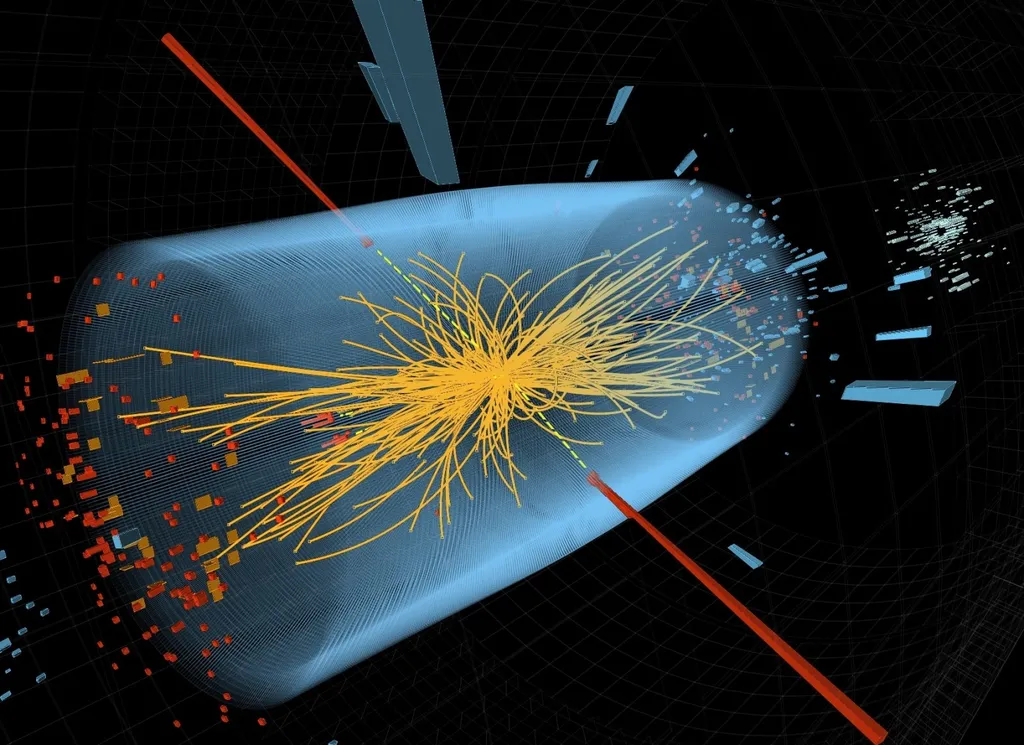
The researchers simulated the decay of these charged Higgs bosons into a W boson and a lighter pseudo-scalar particle (a), and another decay channel where the charged Higgs boson decays into a top quark and a bottom quark. They then analyzed the resulting particles, which include four jets, two of which are from bottom quarks, and missing energy (E_T^{miss}) due to the undetected particles.
The results indicate that, for certain parameters, the signal of charged Higgs bosons with masses of 400 GeV and 600 GeV could be detected with a significance of 5σ, which is considered a strong indication of discovery. Moreover, the researchers presented exclusion limits at the 2σ level in the mass plane of the charged Higgs boson and the pseudo-scalar particle for masses ranging from 400 to 650 GeV. These limits indicate the parameter spaces where the absence of a signal would exclude the existence of charged Higgs bosons in the 2HDM+a model.
While this research is primarily of interest to the field of particle physics, it also has implications for the energy sector. A deeper understanding of fundamental particles and their interactions could potentially lead to advances in energy production, storage, and transmission. For instance, a better grasp of particle physics could contribute to the development of more efficient solar cells, advanced materials for energy storage, or even new approaches to nuclear energy. However, these applications are speculative and would require significant further research.
The research was published in the journal Physical Review D, a peer-reviewed publication of the American Physical Society.
This article is based on research available at arXiv.