
Researchers from the University of California, Riverside, and other institutions have delved into the lesser-explored realm of spin and orbital angular momentum polarization in topological charge pumping. This study, led by Esmaeil Taghizadeh Sisakht and Noejung Park, aims to shed light on the role of spin and orbital degrees of freedom in one-dimensional chiral wires, a topic that has been relatively overlooked despite the widespread study of quantized charge pumping in these systems.
The researchers investigated how topologically quantized charge pumping in insulators generates spin polarizations and whether this mechanism could provide new insights into the well-known phenomenon of spin-selective transport in chiral wires, often referred to as chirality-induced spin selectivity. To do this, they employed time-dependent Schrödinger equations of multi-orbital tight-binding Hamiltonians driven by a circularly polarized electric field.
Their findings are twofold. First, they discovered that the intrinsic screw-like geometry of the system generates a distinctive winding structure governed by a single control parameter. This contrasts with conventional adiabatic pumping mechanisms, which typically require at least two independently modulated parameters. This discovery offers a clearer interpretation of one-dimensional pumping in terms of the topological structure in a (1+1)-dimensional Brillouin zone.
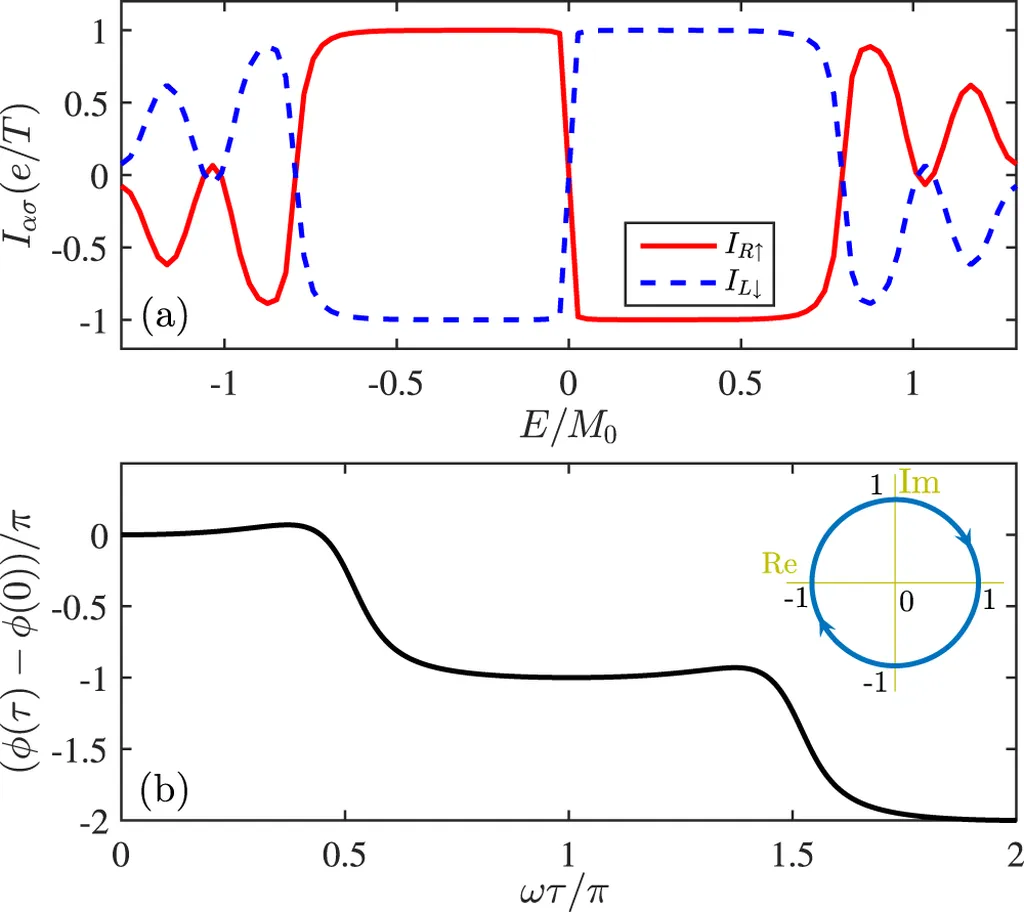
Second, the researchers found that while the energy gap remains open throughout the pumping cycle, the Berry-phase driven real-time dynamics of the charge flow induces a nonequilibrium orbital polarization. Through spin-orbit coupling, this orbital response is partially converted into spin polarization. The direction of this spin polarization is determined by the current and chirality. Drawing an analogy between synthetic (1+1)- and 2-dimensional topological insulators, the researchers suggest that non-trivial spin-orbital dynamics may accompany the anomalous quantum charge Hall states of even-dimensional real materials.
The practical applications of this research for the energy sector could be significant. Understanding and controlling spin polarization in topological materials could lead to more efficient and novel spintronic devices, which could revolutionize data storage and processing. This, in turn, could reduce energy consumption in data centers and other computing facilities, which are known to be significant energy consumers.
The research was published in the journal Physical Review B, a peer-reviewed scientific journal published by the American Physical Society.
This article is based on research available at arXiv.