
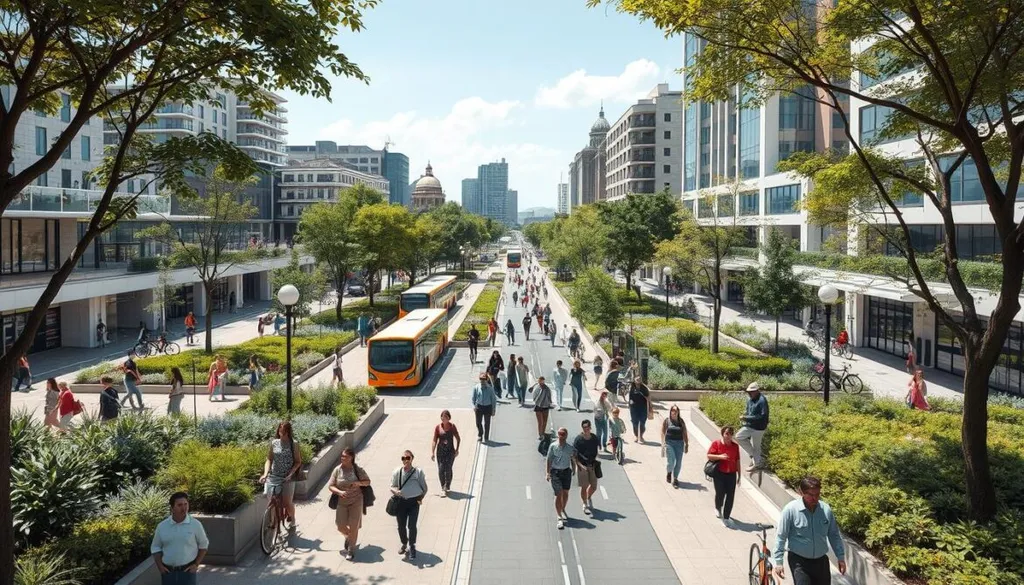
Researchers Yasaman Hakiminejad and Arash Tavakoli from the University of Pennsylvania have developed a new framework to assess pedestrian well-being in urban environments. Their work, published in the Proceedings of the ACM on Interactive, Mobile, Wearable and Ubiquitous Technologies, aims to provide a more comprehensive understanding of how city design impacts pedestrians, which could have significant implications for urban planning and the energy industry.
The researchers introduced a multimodal, human-centered framework that integrates three types of data: continuous physiological sensing, geospatial tracking, and momentary self-reports. This approach allows for a more dynamic and subjective assessment of pedestrian well-being compared to traditional methods that rely on static infrastructure indices or retrospective surveys. By using wearable sensors and GPS-enabled smartphones, the framework can capture real-time data on physiological responses, such as heart rate variability and electrodermal activity, along with self-reported experiences of stress, affect, and perceived infrastructure conditions.
In a case study conducted in the Greater Philadelphia region, the researchers demonstrated the utility of their framework. Participants wore research-grade wearable sensors and carried smartphones during their daily activities. The data collected revealed substantial variability in both subjective experiences and physiological responses among individuals, as well as context-dependent patterns associated with traffic exposure, pedestrian infrastructure quality, and environmental enclosure. The findings suggest that commonly used walkability indices may not fully capture the experiential dimensions of pedestrian well-being.
For the energy industry, this research highlights the importance of considering pedestrian well-being in urban planning and design. As cities become more densely populated and energy demands increase, there is a growing need for sustainable and livable urban environments. By understanding how urban design impacts pedestrian well-being, energy companies can support the development of cities that are not only energy-efficient but also promote the health and well-being of their residents. This could lead to more integrated and human-centered approaches to energy planning and infrastructure development, ultimately contributing to more sustainable and resilient urban communities.
This article is based on research available at arXiv.