
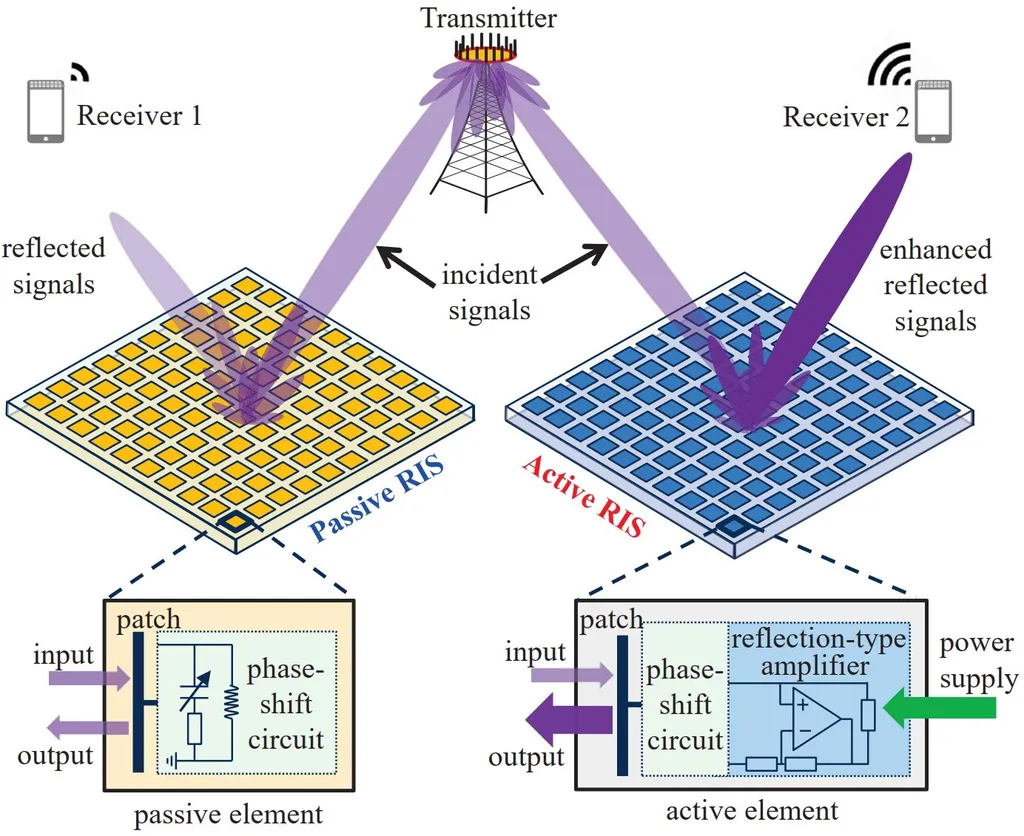
Researchers from the University of Electronic Science and Technology of China, led by Ziyuan Zheng and his team, have published a comprehensive study on the potential of reconfigurable intelligent surfaces (RIS) to enhance satellite networks. Their work, titled “Reconfigurable Intelligent Surface-Enhanced Satellite Networks: Deployment Strategies, Key Capabilities, Practical Solutions, and Future Directions,” was published in the IEEE Journal on Selected Areas in Communications.
Satellite networks are poised to play a crucial role in providing wide-area coverage for future 6G networks. However, they face significant challenges, including service disruptions due to blockages and the need to coexist with terrestrial systems and other satellite layers within increasingly crowded spectrum bands. The researchers propose RIS as a promising solution to these issues. RIS are low-power, programmable surfaces that can redirect electromagnetic waves, offering a cost-effective and energy-efficient alternative to fully active arrays.
The study presents a deployment-first, operations-aware approach to integrating RIS into satellite networks. RIS can serve as both satellite and terminal antennas, as well as inter-satellite or space-ground relays. The researchers identify two key mechanisms through which RIS can enhance satellite networks: connectivity restoration and angular selectivity. Connectivity restoration involves creating virtual line-of-sight links that maintain connectivity even when physical paths are blocked or during mobility. Angular selectivity, on the other hand, involves reshaping interference patterns to improve spectrum reuse.
The researchers also address practical considerations for operating RIS-enabled satellite networks, particularly under high mobility conditions. They discuss strategies for delay-Doppler channel acquisition, predictive beam tracking, and control designs that balance overhead and latency. Additionally, they outline hardware considerations to ensure reliable operation in space.
Looking ahead, the study highlights several forward-looking opportunities. These include the integration of generative artificial intelligence paradigms, the development of multifunctional RIS architectures, and the potential for ubiquitous satellite integrated sensing and communication. The researchers also emphasize the role of RIS in enabling sustainable satellite Internet-of-Things applications.
In summary, the research provides a comprehensive overview of the potential of RIS to enhance satellite networks, offering practical solutions and highlighting future directions. For the energy sector, this technology could lead to more efficient and reliable satellite-based communication systems, which are crucial for remote monitoring, control, and data transmission in energy infrastructure. This could be particularly beneficial for renewable energy projects in remote or hard-to-reach locations, as well as for enhancing the resilience of energy grids.
The research was published in the IEEE Journal on Selected Areas in Communications, a highly respected publication in the field of communications and networking.
This article is based on research available at arXiv.