
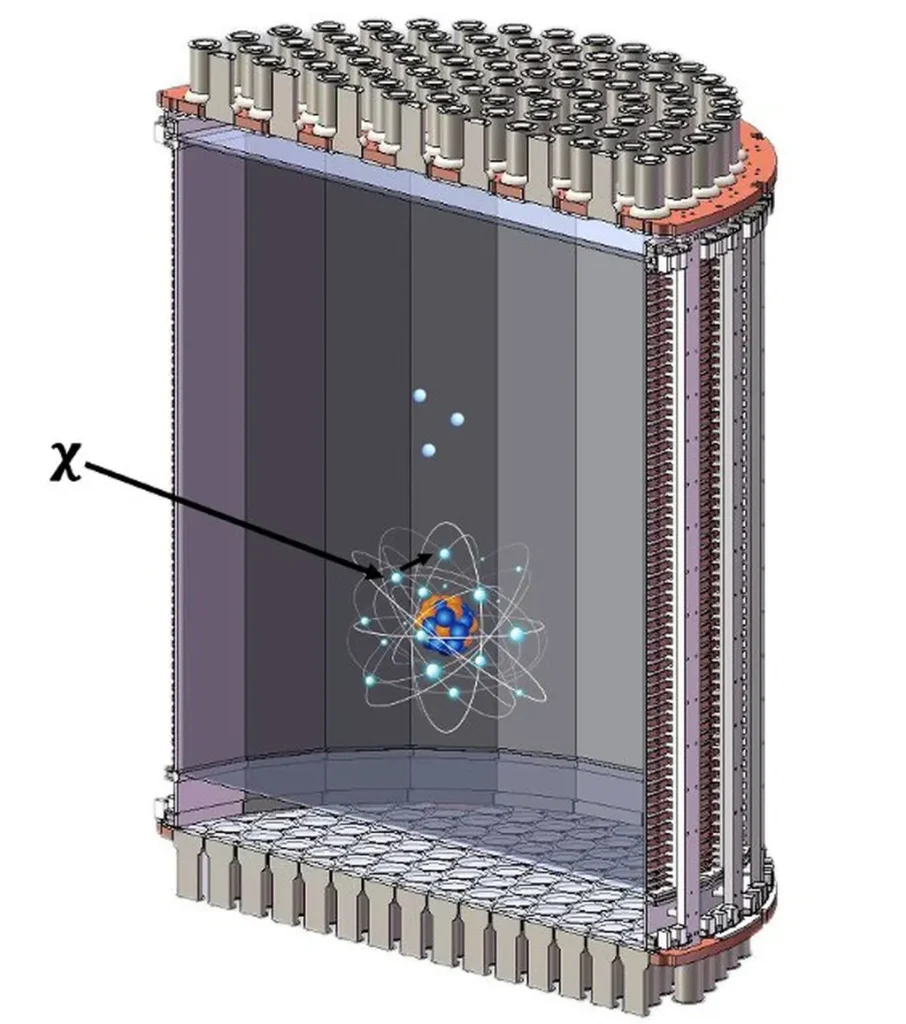
Researchers from the PandaX-xT collaboration, led by Shunyu Yao and colleagues from various institutions including Shanghai Jiao Tong University and the University of Science and Technology of China, have developed an innovative refrigeration system designed to address the cooling needs of large-scale cryogenic distillation systems used in dark matter detection. Their work, published in the journal Cryogenics, presents a solution that could have significant implications for the energy efficiency of industrial cooling processes.
The team’s research focuses on the PandaX-xT dark matter detector, which requires a continuous and substantial cooling power of 20 kW to operate its radon-removal cryogenic distillation system. This system processes liquid xenon at a high flow rate of 856 kg/h (5 liters per minute). The researchers designed a throttling refrigeration system that utilizes carbon tetrafluoride (R14) as a refrigerant to recover and transfer cooling power within the system. This approach allows the cooling power from the liquid xenon in the reboiler, operating at 178 Kelvin, to be transferred to the product xenon cryostat, where it liquefies gaseous xenon. The liquefied xenon can then return to the detector, maintaining a stable cooling cycle and preventing detector instability.
To validate the feasibility of their design, the researchers conducted experiments using ethanol to simulate liquid xenon. The results demonstrated that the cooling power recovery system could achieve 17 kW with an efficiency of 76.5%, and a R14 flow rate of 0.16 kg/s. This innovation eliminates the need for liquid nitrogen or cryocoolers, potentially saving 2414 cubic meters of liquid nitrogen per year or the equivalent power consumption of 230 kW. The researchers also performed process simulations and optimizations using Aspen Hysys to study the influence of key parameters on the system, finding a deviation of less than 2.52% between simulation and experimental results.
The practical applications of this research extend beyond dark matter detection. The throttling refrigeration system could be adapted for use in various industrial processes that require large-scale cooling, such as liquefied natural gas (LNG) production, petrochemical processing, and power generation. By improving energy efficiency and reducing the reliance on cryogenic fluids like liquid nitrogen, this technology has the potential to lower operational costs and environmental impact in the energy sector.
This article is based on research available at arXiv.