
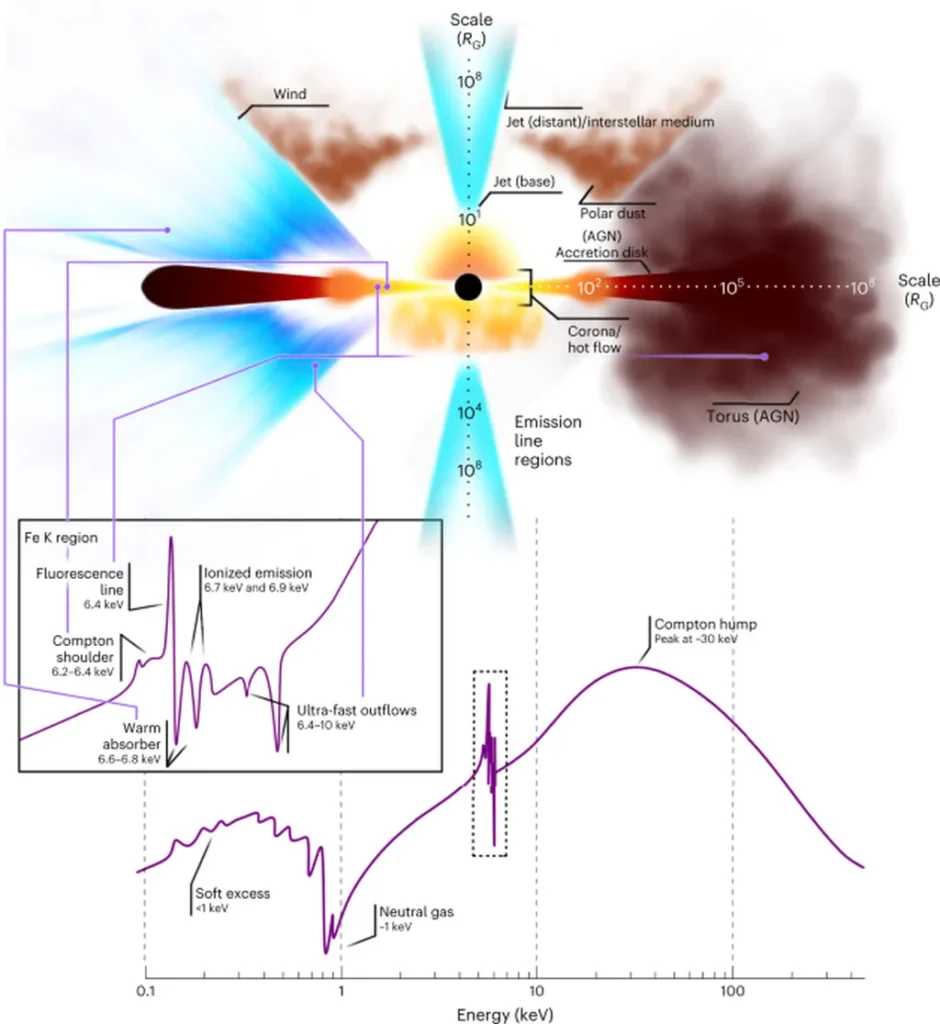
Researchers from Kyoto University, including Kanta Fujiwara, Yoshihiro Ueda, Shoji Ogawa, Yuya Nakatani, and Ryosuke Uematsu, have developed a new model to better understand the X-ray spectra emitted by active galactic nuclei (AGN). Their work, titled “IMPACTX: An X-ray Spectral Model for Polar Dust and Clumpy Torus,” was published in the Astrophysical Journal.
Active galactic nuclei are incredibly bright regions at the centers of some galaxies, powered by supermassive black holes. These regions emit radiation across the electromagnetic spectrum, including X-rays. The researchers aimed to create a model that could accurately represent the X-ray spectra from these complex environments.
The team developed a model called IMPACTX, which stands for Inclusive spectral energy distribution Model of Polar dust And Clumpy Torus for X-ray. This model uses a three-dimensional radiative transfer code called SKIRT to calculate the spectra. The geometry of the model includes a clumpy torus, a doughnut-shaped region of dust and gas around the black hole, and a paraboloid-shell of dusty gas launched from the inner radius of the torus.
The researchers compared their model with a conventional torus-only model and found that the IMPACTX model could better reproduce the observed X-ray and infrared spectra of the nearby Seyfert 2 galaxy NGC 4388. This demonstrates the importance of considering both X-ray and infrared data when studying the nuclear structure of AGN.
While this research is primarily focused on astrophysics, it has potential applications for the energy sector. Understanding the behavior of matter and radiation around black holes can provide insights into the fundamental physics of energy and matter. Additionally, the modeling techniques developed for this research could be adapted for use in energy-related simulations, such as those involving plasma physics or nuclear fusion.
The research was published in the Astrophysical Journal, a peer-reviewed scientific journal that covers all aspects of astronomical research.
This article is based on research available at arXiv.