
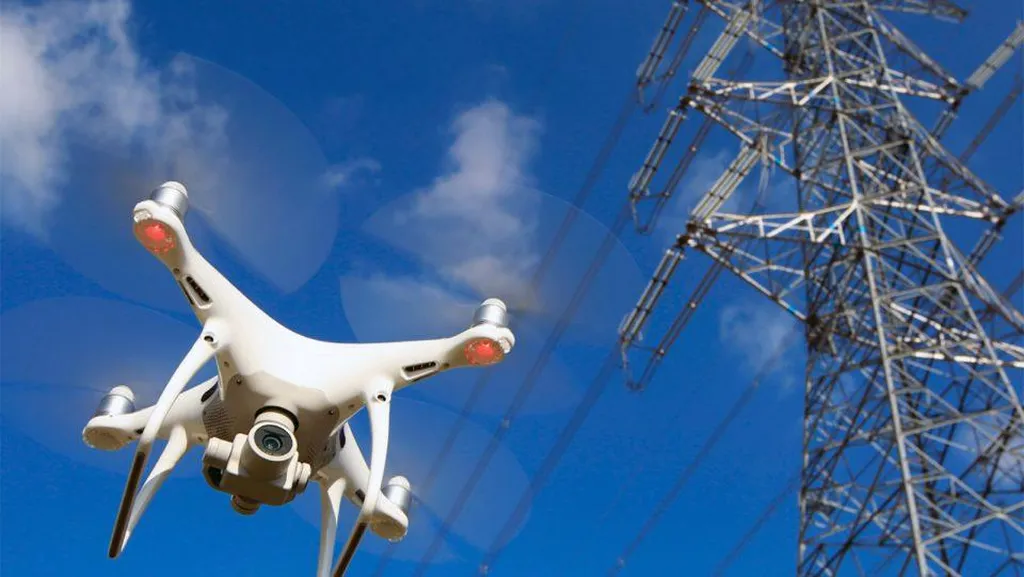
In the realm of energy infrastructure maintenance and inspection, drones have become invaluable tools. Now, researchers from the Robotics and Intelligent Systems Lab at the Swiss Federal Institute of Technology in Lausanne (EPFL), led by Shlok Deshmukh, Javier Alonso-Mora, and Sihao Sun, have made strides in enhancing the capabilities of these aerial platforms. Their work, published in the journal IEEE Robotics and Automation Letters, focuses on improving the control and functionality of aerial manipulators, which are drones equipped with robotic arms.
Aerial manipulators are often constrained by the weight and complexity of their robotic arms. To address this, the researchers developed a lightweight, 2-degree-of-freedom (DoF) arm mounted on a quadrotor drone via a differential mechanism. Despite its simplicity, this design can achieve full six-DoF end-effector pose control, meaning it can position and orient its end-effector (the part of the robot that interacts with the environment) in three-dimensional space. However, the minimal design also introduces challenges such as underactuation (having fewer actuators than degrees of freedom) and sensitivity to external disturbances, like manipulating heavy loads or pushing tasks.
To tackle these issues, the team employed reinforcement learning, a type of machine learning where an agent learns to make decisions by performing actions in an environment to achieve the maximum cumulative reward. They trained a Proximal Policy Optimization (PPO) agent in a simulated environment to generate feedforward commands for the quadrotor’s acceleration and body rates, as well as joint angle targets. These commands were then tracked by an incremental nonlinear dynamic inversion (INDI) attitude controller and a PID joint controller, respectively.
The researchers conducted flight experiments to validate their approach. The results demonstrated centimeter-level position accuracy and degree-level orientation precision, with robust performance under external force disturbances. This means the aerial manipulator can maintain precise control even when pushing or lifting objects, which is crucial for tasks like inspecting or repairing energy infrastructure.
The practical applications for the energy sector are significant. Aerial manipulators with advanced control strategies can be used for inspecting and maintaining power lines, wind turbines, and other energy infrastructure, reducing the need for human workers to perform dangerous tasks. They can also assist in disaster response and recovery efforts, such as inspecting damaged infrastructure or delivering supplies. The research highlights the potential of learning-based control strategies for enabling contact-rich aerial manipulation using simple, lightweight platforms, paving the way for more versatile and capable aerial robots in the energy industry.
This article is based on research available at arXiv.