
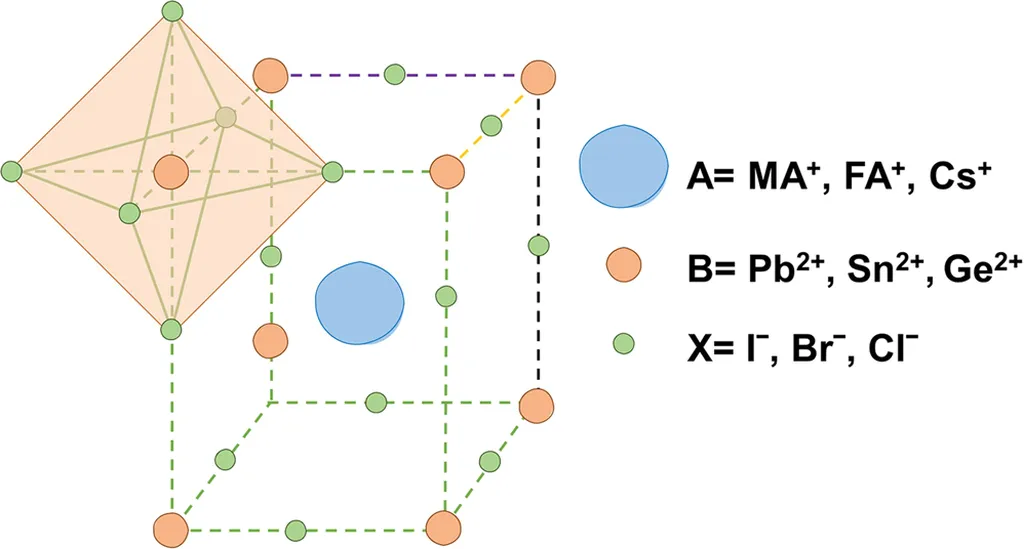
Researchers from the University of Washington, led by Professor Letian Dai, have developed a novel approach to stabilize tin-based perovskite materials for use in flexible optoelectronic devices. Their work, published in the journal Nature Communications, addresses key challenges in the application of lead-free, tin-based halide perovskites in the energy sector.
The team focused on cesium tin iodide (CsSnI3) nanowires, which are promising for flexible and environmentally friendly optoelectronics. However, the rapid oxidation of tin ions (Sn2+ to Sn4+) and poor operational stability have limited their practical use. To overcome these issues, the researchers employed a dual strategy involving aluminium-substrate contact engineering and dipolar interface modification.
First, they used an anodized aluminium foil as a flexible substrate. By exposing specific regions to localized laser ablation, they created metallic aluminium sites that act as reductive contact points. These sites effectively suppress the oxidation of Sn2+ during the growth of CsSnI3 nanowires. This approach ensures the stability and performance of the nanowires in ambient conditions.
Additionally, the researchers introduced a polar interlayer of 3-fluoro-2-nitroanisole. This layer improves energy-level alignment at the interface, suppresses interfacial deprotonation, and enhances charge extraction. The combination of these strategies results in a photodetector with impressive performance metrics. The device exhibits a responsivity of 0.39 A W-1, a specific detectivity of 1.38 * 10^13 Jones, and a wide linear dynamic range of 156 dB under 850 nm illumination.
Moreover, the device demonstrates long-term stability, retaining over 85% of its initial photocurrent after 60 days in ambient air. It also maintains 94% of its initial photocurrent after 1000 bending cycles, highlighting its potential for flexible and durable applications.
The practical applications for the energy sector are significant. Flexible and stable photodetectors based on lead-free perovskites can be integrated into various energy-harvesting and sensing technologies. These include solar cells, photodetectors for smart grids, and sensors for environmental monitoring. The researchers’ approach provides a scalable and effective strategy for stabilizing tin-based perovskites, paving the way for their broader adoption in the energy industry.
This research was published in the journal Nature Communications, providing a robust foundation for future developments in flexible and environmentally benign optoelectronics.
This article is based on research available at arXiv.