
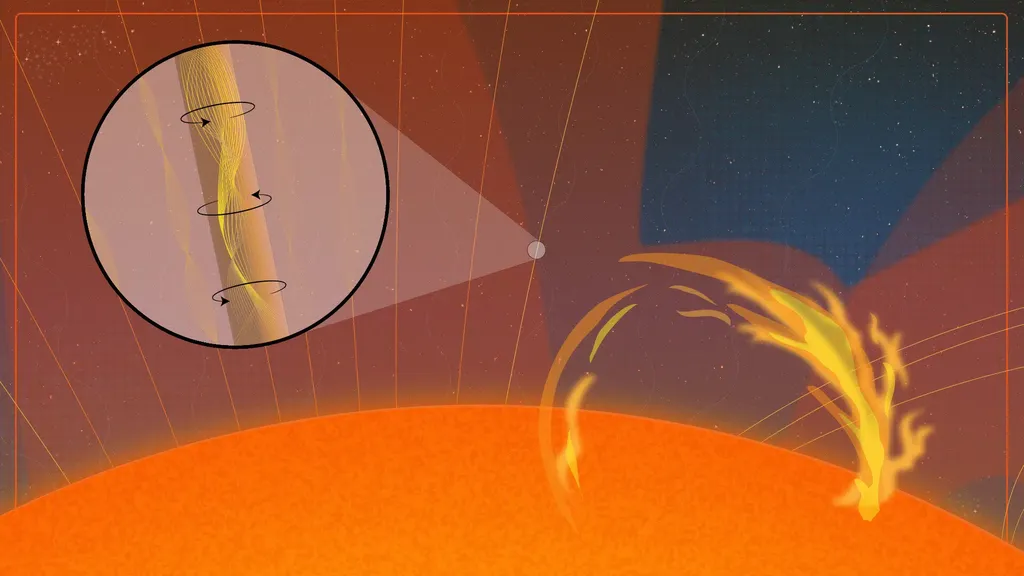
In the realm of solar physics and space weather, a team of researchers led by R. D’Amicis from the National Institute for Astrophysics (INAF) in Italy, along with colleagues from various institutions including the University of California, Los Angeles, and Imperial College London, has been delving into the intricacies of the solar wind. Their findings, published in the journal Astronomy & Astrophysics, shed light on the complex nature of Alfvénic solar wind intervals and their origins on the sun’s surface.
The solar wind, a stream of charged particles released from the sun’s upper atmosphere, can be broadly categorized into fast and slow winds based on their speed. However, the presence of Alfvénic slow wind, which exhibits characteristics typically associated with fast wind, complicates this classification, particularly at intermediate speeds. To better understand these differences and their solar origins, the researchers turned to data from the Solar Orbiter’s Solar Wind Analyzer (SWA), a suite of instruments designed to investigate the solar wind’s composition and behavior.
In September 2022, the Solar Orbiter observed several Alfvénic streams, including one fast wind, three Alfvénic slow wind intervals (AS1, AS2, AS3), and a moderate fast (FH) interval. By combining plasma parameters from all SWA sensors with magnetic field measurements from the Magnetometer (MAG), the researchers conducted a comprehensive analysis of these streams. They employed spectral analysis to characterize Alfvénicity, or the presence of Alfvén waves, in the magnetic and velocity fluctuations of the solar wind.
The study also examined the magnetic connectivity of each stream to its solar source using Potential Field Source Surface extrapolation combined with ballistic backmapping from the spacecraft. This approach allowed the researchers to trace the paths of the solar wind streams back to their origins on the sun’s surface. Proton velocity distribution functions revealed anisotropies and field-aligned beams characteristic of Alfvénic streams, while electron pitch-angle distributions showed clear strahl populations, or beams of electrons moving away from the sun.
The researchers found that oxygen and carbon charge-state ratios were low in the fast wind but higher in the Alfvénic slow wind intervals (AS1-AS3), consistent with their slow wind origins. Magnetic connectivity suggested that the fast wind originated from a large coronal hole, a region on the sun’s surface where the magnetic field is open, allowing particles to escape into space. The Alfvénic slow wind intervals, on the other hand, were linked to various solar structures, including pseudostreamers and negative-polarity coronal holes.
Spectral analysis indicated near energy equipartition in all intervals except AS2, suggesting that the physical processes shaping Alfvénic solar wind streams may vary depending on their solar sources. The combined SWA observations offer key insights into these processes and reinforce the idea that the simple fast/slow wind classification is inadequate for linking solar wind to its sources. The study suggests that Alfvénicity relates to the solar source conditions, highlighting the importance of understanding the complex interplay between the sun and the solar wind.
For the energy sector, particularly for industries reliant on satellite technology and long-distance power transmission, understanding solar wind behavior is crucial. Solar wind can interact with Earth’s magnetic field, causing geomagnetic storms that can disrupt satellite operations and power grids. By improving our understanding of the solar wind’s origins and behavior, researchers can enhance space weather forecasting, helping industries to better prepare for and mitigate the impacts of solar activity. The findings from this study contribute to these efforts by shedding light on the complex nature of Alfvénic solar wind intervals and their solar origins.
This article is based on research available at arXiv.