
In the realm of energy research, understanding the behavior of solar neutrinos can provide valuable insights into the processes that power the sun, our primary energy source. A team of researchers from the Super-Kamiokande Collaboration, led by institutions such as the University of Tokyo and Imperial College London, has made significant strides in this area.
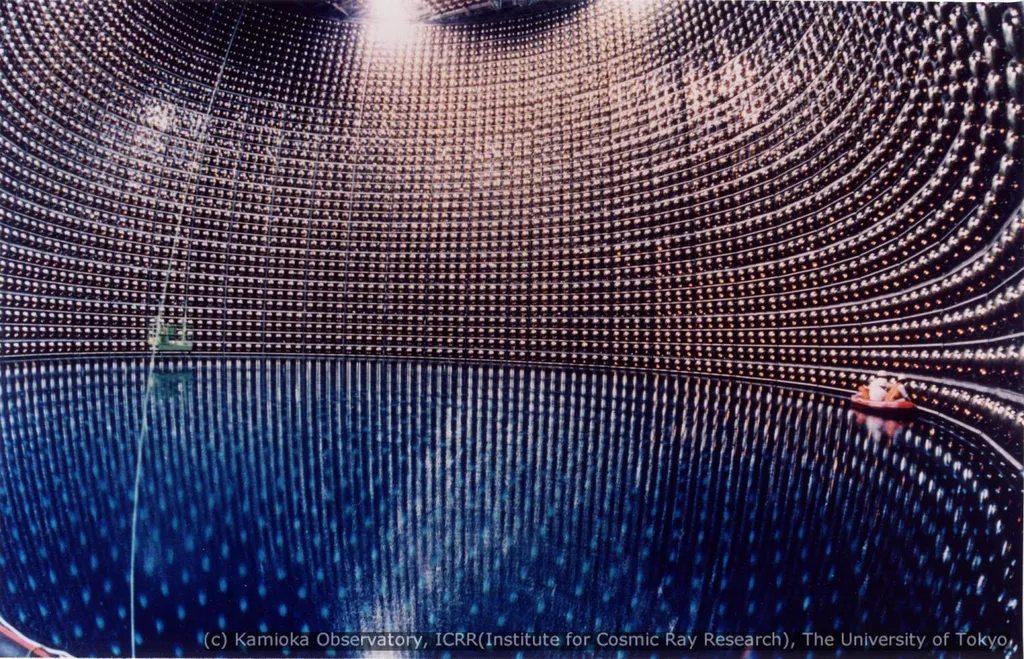
The Super-Kamiokande Collaboration, a group of scientists from various institutions worldwide, has been studying solar neutrinos using the Super-Kamiokande detector in Japan. Their recent research, published in the journal Physical Review D, focuses on measuring the interaction rate of solar neutrinos at lower energies than previously possible.
Solar neutrinos are produced through nuclear fusion reactions in the sun’s core. They provide a unique window into the sun’s interior and the processes that generate the energy we receive on Earth. The researchers measured the interaction rate of boron-8 (8B) solar neutrinos at recoil electron kinetic energies below 3.49 MeV. This is lower than previous measurements and allows for a more comprehensive understanding of neutrino behavior.
To achieve this, the researchers employed advanced machine learning techniques to reduce radioactive background noise, which increases exponentially at lower energies. They used a wideband intelligent trigger and a boosted decision tree for event selection, enabling them to statistically extract solar neutrino interactions at these lower energies.
The study observed a solar neutrino signal between 2.99 MeV and 3.49 MeV with a significance of 2.76 sigma. The data to unoscillated Monte Carlo ratio was found to be 0.307, with uncertainties of plus or minus 0.112 and 0.111, respectively. While this additional low-energy data had a negligible effect on the 1-sigma intervals of the fits to the solar neutrino energy spectrum, it had a noticeable impact on the best fit when using the exponential parameterization.
For the energy sector, understanding solar neutrino interactions can help improve models of the sun’s energy production. This can contribute to more accurate predictions of solar energy output and enhance our ability to harness solar power effectively. Additionally, the advanced machine learning techniques used in this research can be applied to other areas of energy research, such as improving data analysis in nuclear power plants or enhancing the efficiency of solar panels.
In conclusion, the Super-Kamiokande Collaboration’s research provides valuable insights into solar neutrino interactions at lower energies. This work not only advances our understanding of the sun’s energy production but also offers practical applications for the energy sector, particularly in solar power and nuclear energy.
This article is based on research available at arXiv.