
In the realm of theoretical physics, researchers are continually pushing the boundaries of our understanding of the universe. Among them are Emilian Dudas, Susha Parameswaran, and Marco Serra, who are affiliated with the Institut de Physique Théorique in France. Their recent work delves into the intricacies of string theory, offering insights that could have profound implications for our understanding of the cosmos and, potentially, the energy sector.
The researchers present a string theory construction where the particle physics contributions to the one-loop vacuum energy cancel out exactly. This is a significant finding because the vacuum energy, often associated with the cosmological constant, is a critical component in understanding the expansion of the universe. In their model, the gravitational contributions to the vacuum energy are suppressed due to the presence of one or two large extra dimensions. These extra dimensions are “dark,” meaning they do not interact with the visible universe except through gravity.
The model provides an ultraviolet realization of scenarios known as Dark Dimensions and Supersymmetric Large Extra Dimensions. One of the key advantages of this model is that it explains why the Standard Model contributions to the vacuum energy cancel without requiring extremely small mass-splittings. This is a departure from traditional approaches, which often rely on such fine-tuning.
In this theoretical framework, gravity propagates through micron-sized dark dimensions, while the visible and hidden sectors are supported on D-branes. Supersymmetry, a theoretical framework that posits a relationship between matter and force particles, is broken in the dark dimensions through a mechanism known as Scherk-Schwarz. In the D-branes sector, supersymmetry is broken at the string scale through a process called Brane Supersymmetry Breaking, without inducing tadpoles, which are potential instabilities in the theory.
One of the most intriguing aspects of this research is the cancellation of vacuum energy from the visible sector by the vacuum energy of the hidden sector branes. This balance is crucial for maintaining the stability of the universe and could have implications for our understanding of dark energy, which is believed to drive the accelerated expansion of the universe.
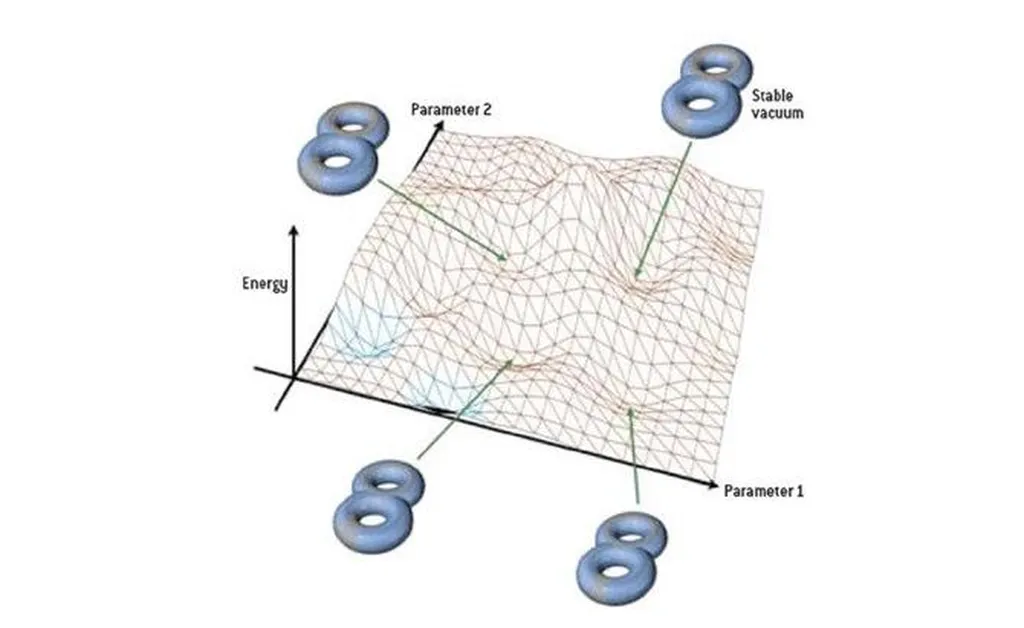
The researchers also discuss moduli stabilization in this setup. Moduli are scalar fields that determine the size and shape of extra dimensions. The interplay between the Scherk-Schwarz one-loop contribution and non-perturbative effects can fix the size of the dark dimensions to be exponentially large in the inverse string coupling. This leads to an exponentially small total vacuum energy, with all moduli stabilized in a de Sitter (dS) saddle point. A de Sitter space is a maximally symmetric solution of Einstein’s field equations, which is often used to model the accelerating expansion of the universe.
While this research is highly theoretical and primarily aimed at advancing our fundamental understanding of the universe, it could have indirect implications for the energy sector. For instance, a deeper understanding of dark energy and the vacuum energy could potentially lead to new insights into energy production and storage. However, it is important to note that any practical applications are likely to be far in the future, as this research is still in its early stages.
The research was published in the Journal of High Energy Physics, a peer-reviewed scientific journal that covers all aspects of high energy physics. The findings represent a significant step forward in our quest to understand the fundamental nature of the universe and could pave the way for future breakthroughs in both theoretical physics and applied energy research.
This article is based on research available at arXiv.