
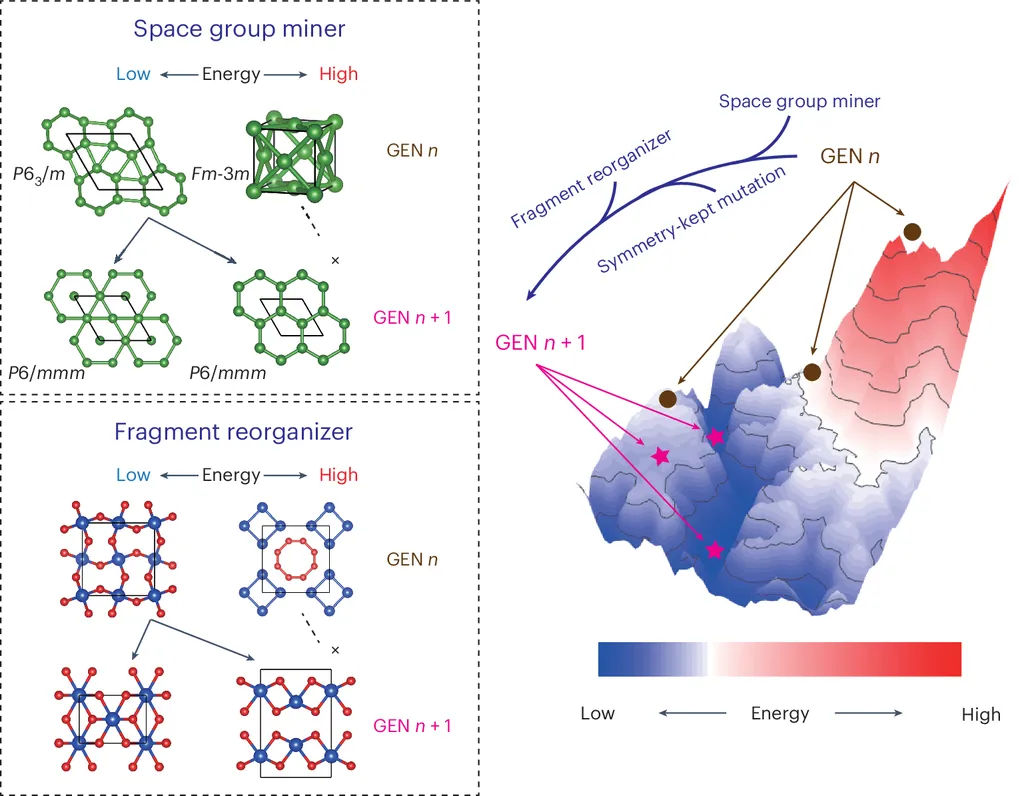
In the realm of energy materials research, a trio of scientists from the University of the Basque Country in Spain—Hao Gao, Yue-Wen Fang, and Ion Errea—have developed a novel approach to predict crystal structures, particularly for materials with significant lattice anharmonicity. Their work, published in the journal Nature Communications, aims to enhance the accuracy and practicality of crystal structure prediction (CSP) methods, which are crucial for discovering new materials with desirable properties.
Crystal structure prediction is a vital tool in materials science, enabling researchers to identify new materials with specific characteristics for various applications, including energy storage, conversion, and transmission. However, traditional CSP methods often struggle with materials that exhibit displacive phase transitions, such as ferroelectrics, thermoelectrics, and superconducting hydrides. In these materials, the ionic contribution to the free energy and lattice anharmonicity play significant roles, limiting the ability of CSP techniques to determine the thermodynamic stability of competing phases.
To address this challenge, the researchers proposed an iterative learning framework that combines evolutionary algorithms, atomic foundation models, and the stochastic self-consistent harmonic approximation (SSCHA). The SSCHA is a variational method that accurately accounts for anharmonic lattice dynamics but is computationally expensive, making it impractical for CSP. On the other hand, machine-learning interatomic potentials offer faster sampling of the energy landscape but require extensive training data and have limited generalization.
The new framework leverages atomic foundation models to enable robust relaxations of random structures, drastically reducing the required training data. When applied to the highly anharmonic H3S system, the framework accurately predicted phase stability and vibrational properties from 50 to 200 GPa, demonstrating good agreement with benchmarks based on density functional theory. Notably, the statistical averaging in the SSCHA reduced the error in free energy evaluation, avoiding the need for extremely high accuracy of machine-learning potentials.
This approach bridges the gap between data efficiency and predictive power, establishing a practical pathway for CSP with anharmonic lattice dynamics. For the energy industry, this method could accelerate the discovery of new materials for energy storage, conversion, and transmission, ultimately contributing to more efficient and sustainable energy systems. The research was published in Nature Communications, a reputable journal for interdisciplinary research in the natural sciences.
This article is based on research available at arXiv.