
In the realm of solar physics and space weather, a team of researchers from Queen’s University Belfast has been delving into the mysteries of the Sun’s behavior, with implications that stretch to our energy infrastructure here on Earth. The team, led by Harry J. Greatorex and including Aisling N. O’Hare, Susanna Bekker, Ryan C. Campbell, Daniel C. Keane, and Ryan O. Milligan, has been analyzing data from the Solar Dynamics Observatory (SDO), a NASA mission that has been observing the Sun since 2010.
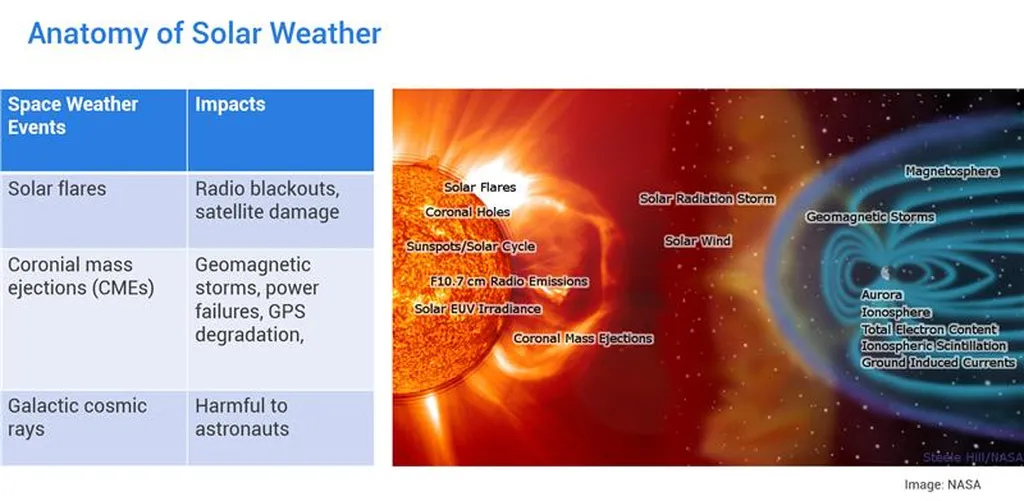
The researchers have been focusing on a phenomenon known as the Extreme Ultraviolet (EUV) late-phase (ELP), a secondary enhancement in warm coronal emission that occurs tens of minutes after the main solar flare. This phenomenon, first identified thanks to the SDO, has been linked to space weather, which can have significant impacts on power grids, satellite operations, and other energy sector assets. However, the statistical behavior and physical origin of the ELP have remained poorly understood—until now.
The team has conducted the most comprehensive review of the ELP to date, based on 15 years of observations from the Atmospheric Imaging Assembly onboard the SDO. From a sample of 5,335 isolated solar flares between 2010 and 2025, they identified and validated 467 ELP events. The overall occurrence rate of the ELP is around 8%, with no significant dependence on the solar cycle and only a modest enhancement in the low-to-mid M-class range of solar flares.
The ELP typically exhibits an onset delay of 19 minutes, a peak-to-peak delay of 88 minutes, and a duration of 93 minutes. The researchers found strong correlations between the ELP rise and decay rates, and between the flare and ELP impulsivity. However, no significant correlation was observed between the flare and ELP phases. A Principal Component Analysis revealed three dominant axes of variation, corresponding to a timescale component, an energy-release intensity axis, and a partitioning of energy between the flare and ELP.
These findings suggest that the evolution of the ELP is governed by both the properties of the flare loops and the energetics driven by magnetic reconnection. This process is likely modulated by a finite magnetic energy budget. The results highlight the importance of long-term observations from the SDO in understanding the evolution of solar flares and the Sun-Earth connection.
For the energy sector, a better understanding of these solar phenomena can lead to improved space weather forecasting. This, in turn, can help in the development of mitigation strategies to protect critical infrastructure, such as power grids and satellite systems, from the potentially devastating effects of solar storms. The research was published in the journal Nature Astronomy.
This article is based on research available at arXiv.