
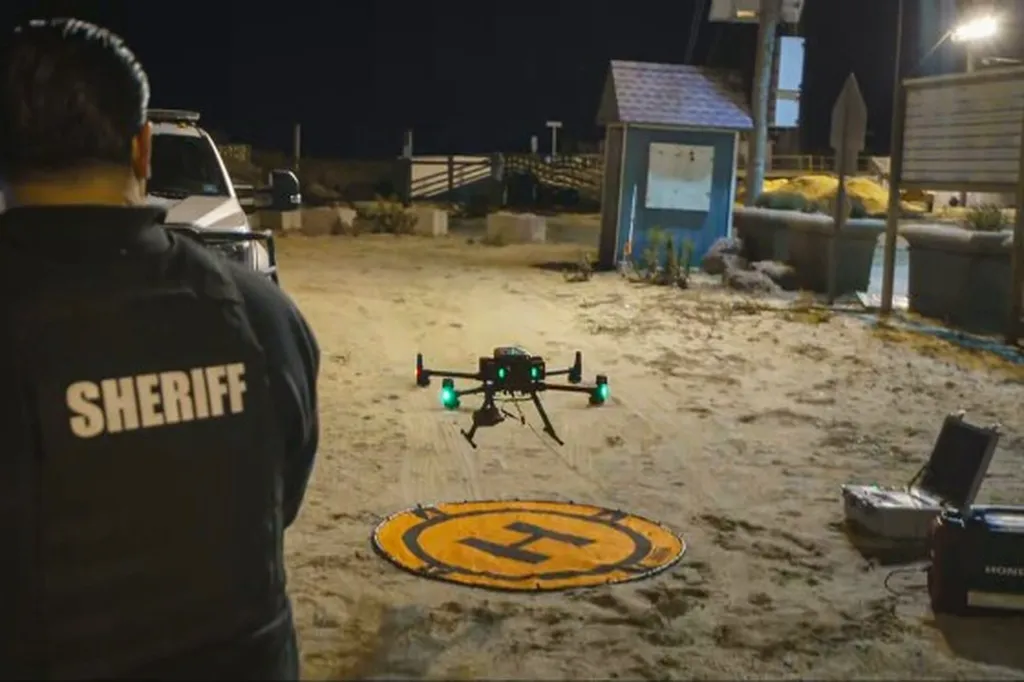
In the rapidly evolving landscape of unmanned aerial vehicles (UAVs), commonly known as drones, ensuring safety and security has become paramount. Researchers Rajdeep Chatterjee, Sudip Chakrabarty, Trishaani Acharjee, and Deepanjali Mishra from the Department of Computer Science and Engineering at the National Institute of Technology Silchar in India have developed a novel approach to address this challenge. Their work, published in the journal Sensors, introduces AUDRON, a deep learning framework designed to detect and classify drones based on their unique acoustic signatures.
Drones are increasingly being used across various sectors, from logistics and agriculture to surveillance and defense. However, their misuse poses significant safety and security risks. Traditional detection methods, such as vision or radar-based systems, can be expensive and intrusive. Acoustic sensing offers a cost-effective and non-intrusive alternative, as drone propellers generate distinctive sound patterns that can be analyzed.
AUDRON leverages these acoustic signatures by employing a hybrid deep learning approach. The framework combines Mel-Frequency Cepstral Coefficients (MFCC) and Short-Time Fourier Transform (STFT) spectrograms, processed through convolutional neural networks (CNNs) and recurrent layers for temporal modeling. Additionally, autoencoder-based representations are used to integrate complementary information before classification. This feature-level fusion enhances the framework’s ability to differentiate drone sounds from background noise.
The researchers evaluated AUDRON’s performance through extensive experiments, achieving high accuracy rates of 98.51 percent in binary classification and 97.11 percent in multiclass classification. These results demonstrate the framework’s effectiveness in reliably detecting and classifying drones under varying conditions. The study highlights the advantages of combining multiple feature representations with deep learning techniques for acoustic drone detection.
The practical applications of AUDRON are significant for the energy sector, particularly in securing critical infrastructure such as power plants, transmission lines, and renewable energy installations. By deploying AUDRON, energy companies can enhance their surveillance capabilities, ensuring the safety and security of their facilities. The framework’s ability to operate in environments where visual or radar sensing may be limited makes it a valuable tool for protecting energy assets from potential threats posed by unauthorized drones.
In conclusion, AUDRON represents a significant advancement in acoustic-based drone detection, offering a reliable and cost-effective solution for enhancing security and surveillance. As the use of drones continues to grow, frameworks like AUDRON will play a crucial role in mitigating risks and ensuring the safe and secure operation of critical infrastructure in the energy sector.
This article is based on research available at arXiv.