
In the realm of advanced materials research, a team of scientists from the Ural Federal University in Russia has been delving into the properties of a specific class of alloys known as Heusler alloys. These materials are of particular interest due to their unique magnetic and electronic transport properties, which could have significant implications for the energy sector, particularly in spintronics and microelectronics.
The researchers, Vyacheslav V. Marchenkov, Alena A. Semiannikova, Evgeny D. Chernov, Alexey V. Lukoyanov, Valentin Yu. Irkhin, Yulia A. Perevozchikova, and Elena B. Marchenkova, have been investigating the properties of Co2MnZ Heusler alloys, where Z can be Al, Ga, Ge, Si, or Sn. Their findings, published in the Journal of Physics D: Applied Physics, provide valuable insights into the potential applications of these materials.
The team measured the electrical resistivity of these alloys over a temperature range from 4.2 to 300 K, as well as the field dependences of the Hall effect and magnetization at 4.2 K in magnetic fields up to 100 kOe and 70 kOe, respectively. These experimental data were found to be in good agreement with theoretical calculations based on density functional theory (DFT), which were used to predict the electronic structure and magnetic moments of the alloys.
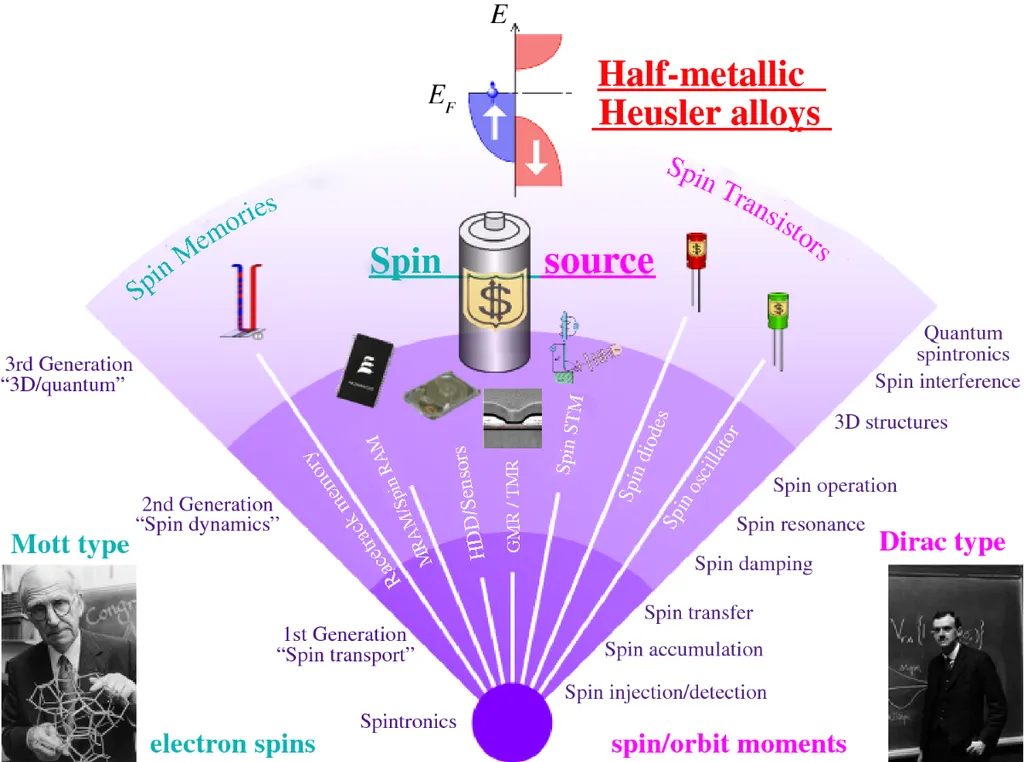
One of the most significant findings of this research is the identification of Co2MnSi as a half-metallic ferromagnet. This means that it exhibits full spin polarization and has a half-metallic gap of about 0.6 eV. Half-metallic materials are highly sought after in spintronics, a field that aims to exploit the spin of electrons for information processing and storage. The unique properties of Co2MnSi could make it a valuable material for developing more efficient and powerful spintronic devices.
In contrast, the other alloys investigated, Co2MnAl, Co2MnGa, Co2MnGe, and Co2MnSn, do not exhibit half-metallicity. However, they do show interesting properties that could be useful in other applications. For instance, Co2MnAl and Co2MnGa are topological semimetals, which means they have Weyl topological points at the Fermi energy. These materials could find applications in microelectronics, where their unique electronic properties could be harnessed to develop new types of devices.
Co2MnGe and Co2MnSn, on the other hand, are found to be usual ferromagnets. While they may not have the same potential for spintronic applications as Co2MnSi, they could still be useful in other areas of the energy sector, such as in the development of more efficient magnetic storage devices.
In summary, this research provides a comprehensive investigation of the magnetic and electronic transport properties of Co2MnZ Heusler alloys. The findings highlight the potential of these materials for various applications in the energy sector, particularly in spintronics and microelectronics. As the demand for more efficient and powerful electronic devices continues to grow, materials like these could play a crucial role in meeting that demand.
This article is based on research available at arXiv.