
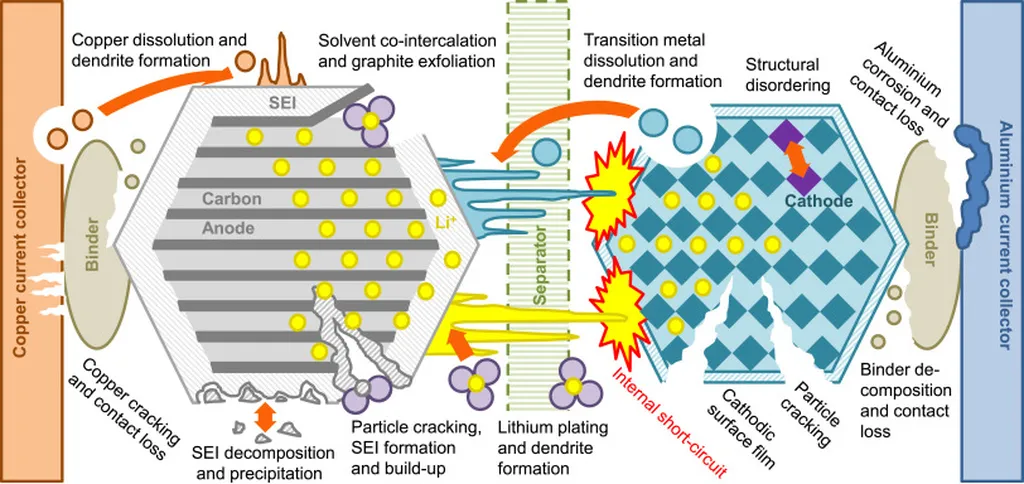
In the realm of energy storage, understanding the degradation of lithium-ion batteries is crucial for improving their lifespan and performance. A team of researchers from Imperial College London, including Mohammed Asheruddin N, Matheus Leal De Souza, Thomas Holland, Catherine Folkson, Gregory Offer, and Monica Marinescu, has delved into the nuances of degradation mode analysis (DMA) in lithium-ion batteries, particularly those with graphite-silicon oxide (C/SiOx) negative electrodes. Their work was recently published in the Journal of The Electrochemical Society.
Degradation mode analysis is a widely used method to break down the capacity fade in batteries into two main components: loss of lithium inventory (LLI) and loss of active material (LAM). However, the researchers found that the measured data, known as pseudo-open circuit voltage (pOCV), includes non-degradation factors such as an SOC-dependent ohmic drop and intrinsic charge-discharge hysteresis. These factors can distort the analysis, leading to what the researchers term “Phantom LAM and LLI”—apparent material loss that is actually an artifact of the analysis method rather than true degradation.
To address this issue, the researchers used two commercial 21700 cells, the LG M50T and Molicel P45B, which have different resistance profiles. They extracted an SOC-dependent instantaneous resistance from the first pulse step and applied an IR correction to the pOCV before fitting. For the LG M50T cell, the IR correction significantly affected the analysis, lifting the low-rate discharge pOCV by 13 to 27 millivolts with aging. Without this correction, the analysis increasingly under-diagnosed positive electrode LAM and suppressed LLI, leading to an inflated apparent loss of graphite.
For the Molicel P45B cell, the choice of voltage window and charge-discharge branch also played a crucial role. The researchers found that using a branch-fair voltage window of 3.0 to 4.2 volts, the end-of-life charge-branch DMA reported higher positive electrode LAM and LLI, while the discharge branch recovered larger silicon LAM. Adjusting the voltage window further under-reported silicon LAM by removing the silicon-sensitive low-voltage tail.
Based on their findings, the researchers propose a practical protocol for more accurate degradation mode analysis. They recommend correcting only the instantaneous ohmic term, harmonizing the voltage window, and basing quantitative attribution on the discharge branch. Anomalous or negative component LAMs on charge should be treated as allocation artifacts rather than recovery.
This research highlights the importance of accurate degradation mode analysis in understanding and improving the performance of lithium-ion batteries. By refining the analysis methods, the energy industry can better address the factors contributing to battery degradation and develop more effective strategies for extending battery life and enhancing energy storage systems.
This article is based on research available at arXiv.