
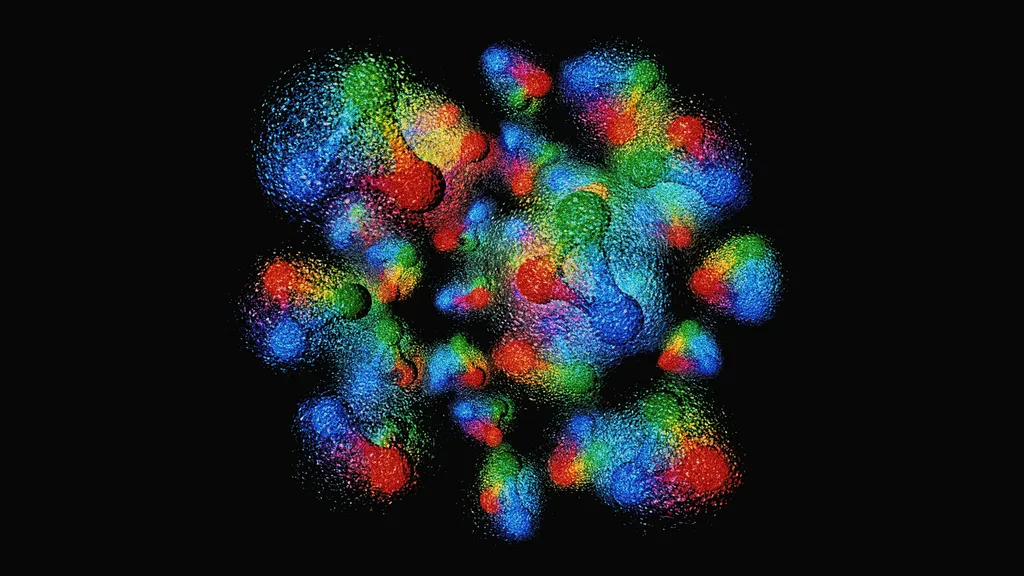
Researchers Urban Vernik, Kai Hebeler, and Achim Schwenk from the Technical University of Darmstadt have been exploring the impact of newly identified quark mass dependent three-nucleon forces in medium-mass nuclei. Their work, published in the journal Physical Review Letters, delves into the implications of these forces on nuclear structures, which could have indirect relevance to the energy sector, particularly in understanding nuclear processes involved in energy production.
The study focuses on a specific interaction term, characterized by the coupling F2, which has been found to have a significant impact on nuclear matter. The researchers combined this new interaction with established three-nucleon interactions up to high orders of chiral effective field theory. They employed two different strategies for fitting the low-energy couplings: one based solely on few-body observables and another that also incorporated data from the oxygen-16 nucleus.
The findings indicate that the F2 interaction does indeed affect the energies and radii of medium-mass nuclei. However, these changes are largely attributed to alterations in the short-range couplings. Despite the significant impact of the F2 interaction, the researchers did not observe systematic improvements in the reproduction of medium-mass nuclei when this additional interaction was included. This suggests that while the F2 interaction is important, it may not be the key to resolving all discrepancies in nuclear structure models.
For the energy sector, understanding these fundamental nuclear forces can provide deeper insights into the behavior of nuclear materials used in energy production, such as those in nuclear reactors or future fusion energy systems. While the direct practical applications of this research may not be immediate, it contributes to the broader scientific understanding of nuclear physics, which is crucial for advancing energy technologies.
This article is based on research available at arXiv.