
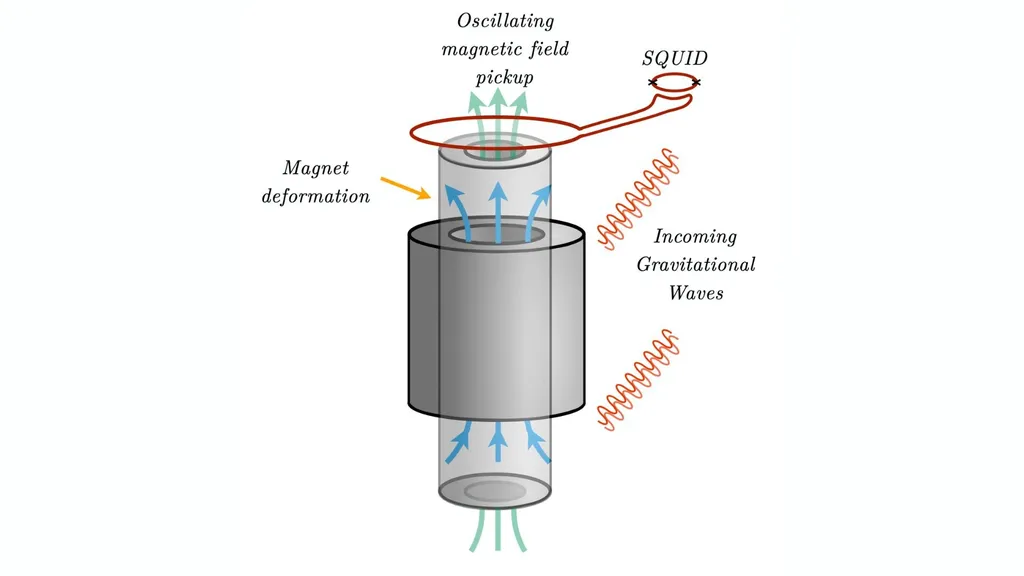
Researchers Sebastian Schenk, Kristof Schmieden, and Pedro Schwaller, affiliated with the University of Chicago, have published a study exploring the potential of electromagnetic cavities to detect high-frequency gravitational waves. Their work, titled “Signatures of High-Frequency Gravitational Waves in Electromagnetic Cavities,” was published in the journal Physical Review D.
Gravitational waves, or GWs, are ripples in spacetime caused by massive, accelerating objects. While current detectors like LIGO are sensitive to low-frequency GWs, detecting high-frequency GWs remains a challenge. The researchers propose a novel approach using electromagnetic cavities, which are structures that confine electromagnetic fields and can resonate at specific frequencies.
The study focuses on cylindrical and spherical cavities, examining how GWs couple with the dominant electromagnetic resonances within these cavities. The researchers calculate the coupling coefficients in the transverse-traceless gauge, which is particularly relevant for this regime. They also consider the superposition of degenerate modes to assess the cavities’ angular sensitivity.
For transient signals, such as those from primordial black hole mergers, the researchers find that a high-quality factor, which measures the cavity’s resonance sharpness, does not necessarily enhance experimental sensitivity. In fact, even in the most optimistic scenarios, only mergers occurring within the solar system would deposit enough energy in the cavity to be observable.
The practical applications of this research for the energy sector are not direct, as the study is primarily focused on fundamental physics and the detection of gravitational waves. However, advancements in detection technologies can often lead to spin-off technologies that benefit various industries, including energy. For instance, improved sensing technologies could enhance monitoring and control systems in energy infrastructure. Moreover, the study’s findings could contribute to the broader understanding of astrophysical phenomena, which may have implications for energy generation and distribution in the future.
In summary, the researchers have proposed a new method for detecting high-frequency gravitational waves using electromagnetic cavities. While the direct applications for the energy sector are limited, the study contributes to the ongoing efforts to expand our detection capabilities and understand the universe better. The research was published in Physical Review D, a peer-reviewed journal dedicated to the publication of fundamental research in all areas of theoretical and experimental particle physics.
This article is based on research available at arXiv.