
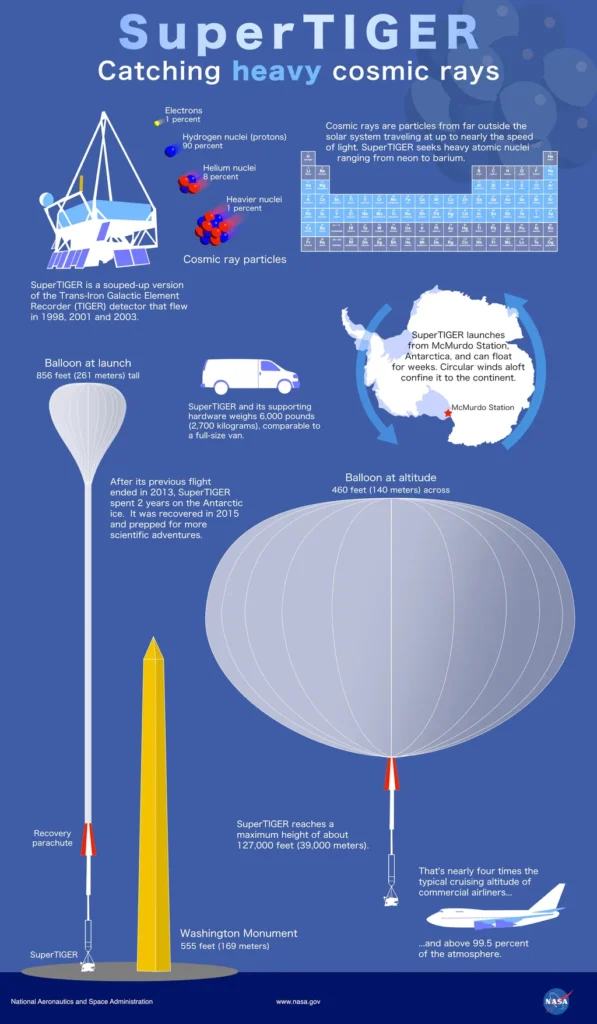
In the realm of energy and particle physics, a team of researchers from the University of Maryland, including Angelina Sherman, Ke Fang, and Dan Hooper, have been exploring the capabilities of a upcoming balloon-based experiment called the Payload for Ultrahigh Energy Observations (PUEO). This experiment aims to detect ultrahigh-energy neutrinos, which could provide valuable insights into cosmic rays and exotic physics scenarios. Their findings were recently published in the journal Physical Review D.
The PUEO experiment is designed to detect neutrinos with energies ranging from 1 to 1000 EeV (exa-electron volts), a range that has not been extensively explored before. Neutrinos are subatomic particles that rarely interact with matter, making them difficult to detect but valuable for studying cosmic events. By analyzing the sensitivity of PUEO, the researchers hope to better understand the origins and composition of ultrahigh-energy cosmic rays, which are the most energetic particles in the universe.
One of the key aspects of the research is evaluating PUEO’s sensitivity to cosmogenic neutrinos. These neutrinos are produced when ultrahigh-energy cosmic rays interact with the cosmic microwave background radiation. By detecting these neutrinos, PUEO can provide information about the proton fraction of ultrahigh-energy cosmic rays. The researchers found that PUEO will be particularly effective in scenarios where the cosmic-ray sources evolve rapidly and protons are accelerated to extremely high energies.
In addition to studying cosmogenic neutrinos, the researchers also considered PUEO’s potential to probe exotic physics scenarios. One such scenario involves the decay of ultraheavy dark matter particles, which could produce neutrinos detectable by PUEO. While gamma-ray observations are generally more sensitive to decaying particles, PUEO is expected to set the strongest neutrino-detector constraints above 10^19 eV. This could provide valuable insights into the nature of dark matter, which makes up a significant portion of the universe’s mass but remains poorly understood.
Another exotic scenario explored by the researchers involves cosmic strings, hypothetical one-dimensional defects in spacetime that could have formed in the early universe. These cosmic strings could radiate neutrinos, and PUEO’s sensitivity to these neutrinos could provide constraints on the properties of cosmic strings. The researchers found that PUEO will be able to set the strongest constraints on some models of cosmic strings, potentially shedding light on the early universe’s evolution.
For the energy sector, the practical applications of this research are not immediate, but understanding the fundamental particles and forces of the universe can have long-term implications. For instance, advancements in particle physics have historically led to technological innovations, such as medical imaging techniques and nuclear energy. Moreover, studying cosmic rays and neutrinos can provide insights into the processes that govern the universe, which could inform our understanding of energy production and consumption on Earth.
In conclusion, the research by Angelina Sherman, Ke Fang, and Dan Hooper highlights the potential of the PUEO experiment to advance our understanding of ultrahigh-energy cosmic rays and exotic physics scenarios. While the practical applications for the energy sector may not be immediate, the fundamental knowledge gained from such research can have far-reaching implications for technology and energy production. The study was published in Physical Review D, a peer-reviewed journal dedicated to research in particle physics, field theory, gravitation, and cosmology.
This article is based on research available at arXiv.