
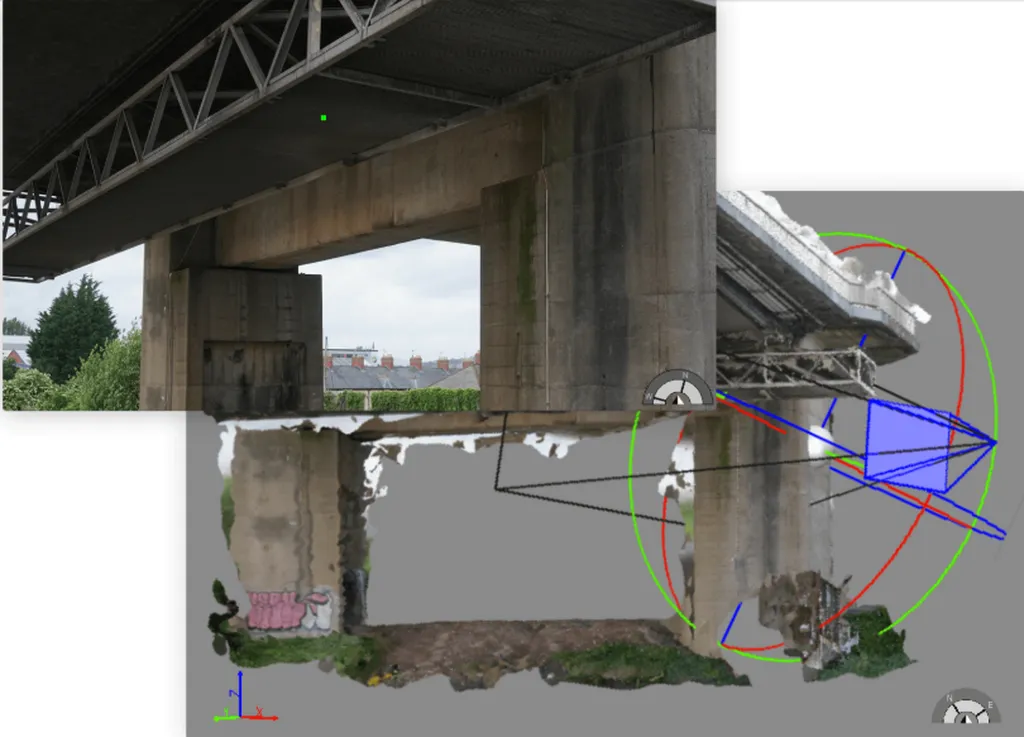
Researchers Alireza Moayedikia and Sattar Dorafshan, affiliated with the University of Waterloo, have developed a novel approach to bridge deck inspection that could significantly improve the maintenance of aging infrastructure. Their work, published in the IEEE Transactions on Intelligent Transportation Systems, focuses on automating the detection of delamination in concrete bridge decks using advanced machine learning techniques.
The researchers address a critical challenge in civil infrastructure maintenance: the need for automated inspection techniques that can overcome the limitations of traditional visual assessments. Ground Penetrating Radar (GPR) and Infrared Thermography (IRT) are two non-destructive evaluation methods that can detect subsurface defects, but each has its own constraints. GPR can struggle with moisture and shallow defects, while IRT is weather-dependent and has limited depth penetration. To overcome these limitations, Moayedikia and Dorafshan developed a multi-modal attention network that fuses temporal patterns from radar data with spatial signatures from thermal images.
The architecture of their network includes temporal attention for processing radar data, spatial attention for thermal features, and cross-modal fusion with learnable embeddings. This approach allows the network to discover complementary defect patterns that might be invisible to individual sensors. Additionally, the researchers incorporated uncertainty quantification through Monte Carlo dropout and learned variance estimation, decomposing uncertainty into epistemic (arising from model parameters) and aleatoric (inherent in the data) components. This is crucial for safety-critical decisions, as it allows the system to quantify and communicate its confidence in its predictions.
Experiments conducted on five bridge datasets demonstrated that the multi-modal attention network substantially outperforms baseline methods in accuracy and Area Under the Curve (AUC), especially on balanced to moderately imbalanced data. Ablation studies showed that cross-modal attention provides critical gains beyond within-modality attention, and multi-head mechanisms achieve improved calibration. The uncertainty quantification also reduced calibration error, enabling the system to reject uncertain cases and thereby improve decision-making.
However, the researchers noted that under extreme class imbalance, attention mechanisms can be vulnerable to majority class collapse. This finding provides actionable guidance for practitioners: while the attention-based architecture performs well across typical scenarios, extreme imbalance requires specialized techniques. The system is designed to be deployment-efficient, enabling real-time inspection with well-characterized capabilities and limitations.
The practical applications of this research for the energy sector are significant. Many energy infrastructure projects, such as pipelines, power plants, and renewable energy installations, require regular inspection and maintenance to ensure safety and efficiency. Automated inspection techniques like the one developed by Moayedikia and Dorafshan can help energy companies identify and address potential issues more quickly and accurately, reducing downtime and maintenance costs. Additionally, the uncertainty quantification component can provide valuable insights for risk management and decision-making, helping energy companies make more informed and safer operational decisions.
In summary, the work of Alireza Moayedikia and Sattar Dorafshan represents a significant advancement in the field of automated infrastructure inspection. Their multi-modal attention network, with its ability to fuse data from different sensors and quantify uncertainty, offers a robust and efficient solution for detecting delamination in concrete bridge decks. The insights and techniques developed in this research have broad applicability, including in the energy sector, where they can contribute to improved safety, efficiency, and cost-effectiveness.
This article is based on research available at arXiv.