
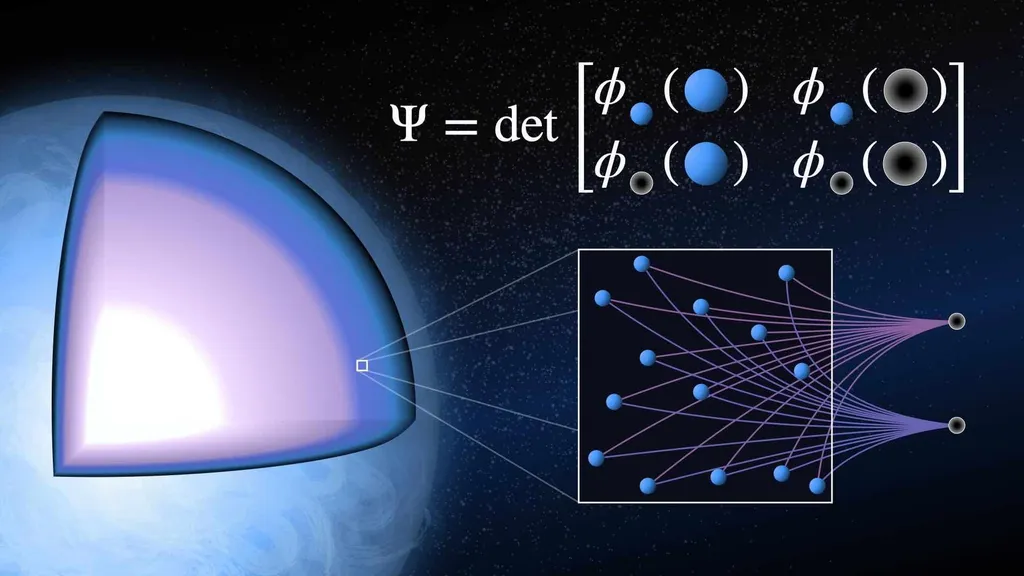
In the realm of astrophysics and nuclear physics, a team of researchers from the University of York, Giorgio Almirante, Theodora Kaskitsi, and Michael Urban, have been delving into the intriguing properties of neutron stars, particularly the superfluid behavior within their inner crusts. Their work, published in the journal Physical Review Letters, offers insights that could have implications for understanding the dynamics of these enigmatic cosmic objects.
The inner crust of neutron stars is a complex environment where nuclear matter is thought to form a crystal lattice of clusters, surrounded by a sea of superfluid neutrons. The researchers aimed to understand the interplay between this crystalline structure and the superfluid properties of the neutrons. To do this, they employed advanced theoretical models, specifically Hartree-Fock-Bogoliubov calculations, which allow for a detailed description of the quantum mechanical behavior of the particles involved.
The team introduced a relative flow between the clusters and the surrounding neutron gas, which led to a phase shift in the complex order parameter describing the superfluid. This shift revealed a counterflow of neutrons within and outside the clusters when observed from the superfluid’s rest frame. By analyzing this current, the researchers were able to compute the neutron superfluid fraction.
Their findings indicate that at densities above 0.03 fm^-3, more than 90% of the neutrons in this region are effectively superfluid. This high fraction of superfluid neutrons is notable because it suggests that the inner crust of neutron stars could act as a significant reservoir of angular momentum. This reservoir could potentially explain the sudden spin changes, or glitches, observed in pulsars, which are rotating neutron stars emitting beams of electromagnetic radiation.
The results also align well with previous studies using different theoretical approaches, such as linear response theory combined with the Bardeen-Cooper-Schrieffer approximation. The consistency across different methods strengthens the confidence in these findings. Moreover, the superfluid fraction approaches the hydrodynamic limit for strong pairing, indicating that the superfluid behavior is robust and not overly sensitive to the details of the interaction or the specific geometry of the crystal lattice.
For the energy sector, while this research is primarily astrophysical, understanding the fundamental properties of nuclear matter under extreme conditions can have broader implications. It can inform the development of advanced materials and technologies that rely on similar quantum mechanical principles. For instance, the study of superfluids and superconductors is crucial for advancements in energy transmission, storage, and even fusion energy research. The insights gained from such extreme environments can inspire innovations in these areas, potentially leading to more efficient and sustainable energy solutions.
This article is based on research available at arXiv.