
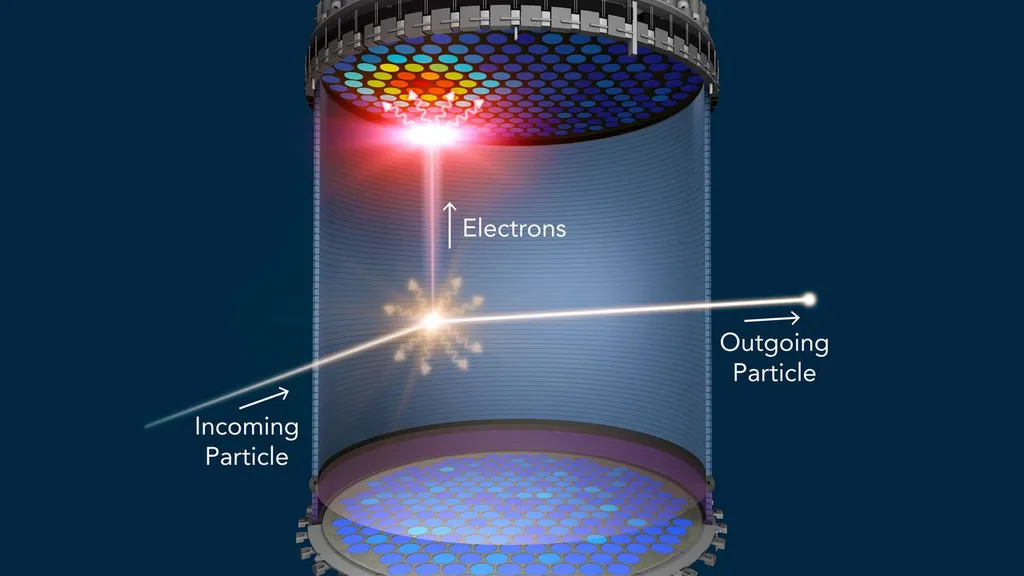
The XENON Collaboration, a group of researchers affiliated with various institutions worldwide, has recently published a study in the journal Physical Review Letters, exploring the potential of detecting low-mass dark matter particles through their interactions with electrons. This research could have significant implications for our understanding of dark matter and its role in the universe, including potential applications in the energy sector.
Dark matter is a mysterious substance that makes up approximately 27% of the universe’s mass-energy content, yet it does not emit, absorb, or reflect light, making it invisible to traditional detection methods. The XENON Collaboration’s research focuses on a specific type of dark matter, known as solar reflected dark matter, which is thought to interact with ordinary matter through a heavy mediator particle.
The researchers analyzed data from the XENON1T and XENONnT experiments, which are designed to detect weakly interacting massive particles (WIMPs), a hypothetical type of dark matter. By considering dark matter-electron scattering and employing dedicated event selections to reduce the detection threshold, the team was able to enhance their sensitivity to low-mass dark matter particles.
The study presents new constraints on the dark matter-electron scattering cross-section for masses ranging from 4.6 keV/c² to 20 keV/c², and from 0.2 MeV/c² to 2 MeV/c². These constraints are the first of their kind and provide valuable insights into the nature of dark matter and its interactions with ordinary matter.
In the context of the energy industry, understanding the properties of dark matter could have significant implications for the development of new energy technologies. For example, dark matter could potentially be harnessed as a source of clean, renewable energy. Additionally, a better understanding of dark matter could help improve our models of the universe and its evolution, leading to more accurate predictions about the behavior of stars, galaxies, and other astronomical objects.
While the practical applications of this research are still speculative, the XENON Collaboration’s work represents an important step forward in our quest to understand the fundamental nature of the universe. As our knowledge of dark matter continues to grow, so too will our ability to harness its potential for the benefit of society.
This article is based on research available at arXiv.