
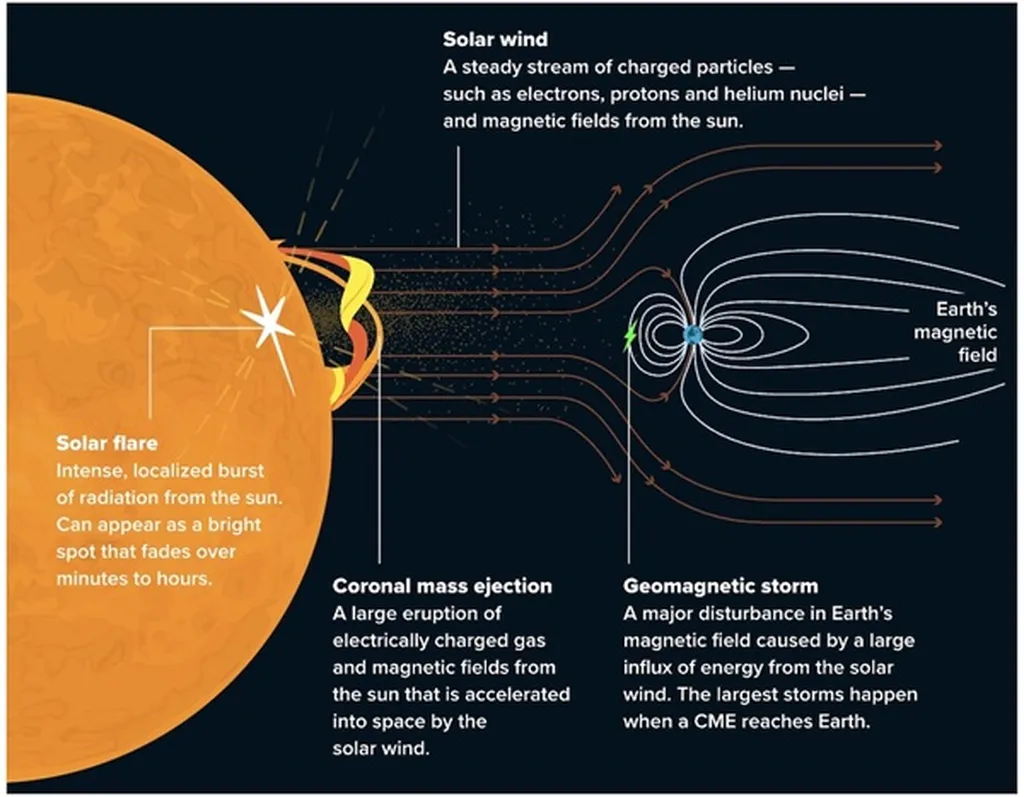
In the realm of solar physics and energy research, understanding the dynamics of solar flares is crucial for predicting space weather and its potential impacts on Earth’s power grids and satellite communications. Researchers Hanya Pan, Astrid M. Veronig, and Rui Liu from the University of Graz in Austria have delved into the intricate details of solar flares, specifically focusing on the evolution of X-ray double sources in a solar flare that occurred on August 28, 2022. Their findings, published in the journal Astronomy & Astrophysics, offer valuable insights into the energy release processes in the post-flare current sheet during the decay phase of solar flares.
Solar flares are intense bursts of radiation originating from the release of magnetic energy in the sun’s atmosphere. The standard model of solar flares posits that magnetic reconnection at a vertical current sheet above the flare arcade plays a pivotal role in these eruptions. The supra-arcade region, where this vertical current sheet is located, emits X-ray and extreme ultraviolet (EUV) radiation that reflects the underlying energy release and transport processes. Previous studies have primarily focused on the impulsive phase of flares, but Pan, Veronig, and Liu emphasize the importance of understanding the decay phase to gain a comprehensive view of the flaring scenario.
The researchers analyzed an M6.7-class limb flare using observations from the Solar Orbiter (SolO) and the Solar Dynamics Observatory (SDO). The Spectrometer/Telescope for Imaging X-rays (STIX) onboard SolO provided continuous X-ray observations for over two hours, revealing a multi-phase evolution with varying velocities and multiple substructures. Notably, higher-energy components consistently appeared at higher altitudes, a phenomenon observed in a double coronal source during the decay phase. This double source was dominated by thermal emission and exhibited an asymmetric energy distribution, contrasting with previous studies that showed a symmetric distribution during the impulsive phase.
The findings from this study highlight the spatio-temporal complexity of the energy release process in the post-flare current sheet during the decay phase. The researchers suggest that the observed height-energy relation and the asymmetric energy distribution of the double source provide valuable insights into the structure and evolution of the current sheet. Understanding these processes is crucial for improving space weather forecasting and mitigating the potential impacts of solar flares on Earth’s energy infrastructure.
In practical terms for the energy sector, this research contributes to the broader effort of predicting and preparing for space weather events. Solar flares can disrupt power grids, satellite communications, and other critical infrastructure. By enhancing our understanding of the underlying physics of solar flares, researchers can develop more accurate models and forecasting tools, enabling energy providers to take proactive measures to protect their systems and ensure reliable energy delivery.
As the world becomes increasingly reliant on advanced technologies and interconnected systems, the importance of space weather research cannot be overstated. The work of Pan, Veronig, and Liu represents a significant step forward in unraveling the complexities of solar flares and their potential impacts on Earth’s energy infrastructure. Their findings, published in Astronomy & Astrophysics, underscore the need for continued investment in space weather research and the development of robust mitigation strategies to safeguard our energy systems against the vagaries of space weather.
This article is based on research available at arXiv.